01 / Reading Guide
Reading Guide
Citation
Holt, J. (2023). Systems Engineering Demystified (2nd ed.). Packt Publishing.
Chapter Summary
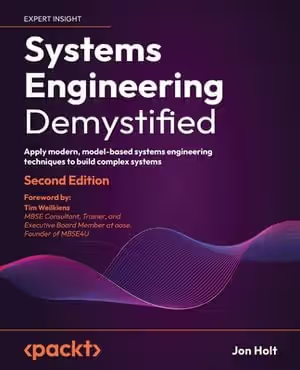
The second edition has thirteen chapters in four parts, about 530 pages in print. Its organising idea is model-based systems engineering (MBSE): the Systems Modeling Language (SysML) is the notation, and Chapters 3–8 each end with a section called "Defining the Framework", which adds the chapter's concepts to a set of model views. Almost every chapter closes with a summary, self-assessment tasks and references. Packt's description says the edition covers new approaches to MBSE and its deployment using the "Trinity" approach, and ends with a new section on effective approaches drawn from the author's thirty years in the field.
Chapter 1: Introduction to Systems Engineering
Part I, "Introduction to Systems Engineering", begins with a brief history of systems engineering, a definition, and the case for why it is needed. Packt frames the motivation as "three evils": complexity, ambiguous communication and lack of understanding.
Chapter 2: Model-Based Systems Engineering
Introduces MBSE and its evolution, and what modelling means in practice. Two languages are distinguished: SysML as the "spoken language" of models, and an ontology as the domain-specific language that fixes what the model's terms mean.
Chapter 3: Systems and Interfaces
Part II, "Systems Engineering Concepts", opens with definitions of systems and the description of interfaces between them, ending with the first "Defining the Framework" section.
Chapter 4: Life Cycles
Introduces life cycles and life cycle models, the stages a system passes through and the ways they can be arranged.
Chapter 5: Systems Engineering Processes
Covers process fundamentals and concepts, process modelling, and the use of process models to represent standards, so that an organisation can show how it complies with them.
Chapter 6: Needs and Requirements
Part III, "Systems Engineering Techniques", starts with needs and requirements, how to visualise them with different SysML diagrams, and where they sit in the life cycle and processes.
Chapter 7: Modeling the Design
Defines design and architectural design and relates design modelling to best-practice processes.
Chapter 8: Modeling Verification and Validation
Defines testing concepts and shows how to build model views for verification and validation, again tied to best-practice processes.
Chapter 9: Methodologies
Introduces methodologies in general and two in particular, SAFe and OOSEM, and discusses how methodologies relate to MBSE.
Chapter 10: Systems Engineering Management
A survey of the management processes: project planning, decision management, project assessment and control, risk management, information management, configuration management, measurement and quality assurance.
Chapter 11: Deploying MBSE
Part IV, "Next Steps", introduces the Trinity approach to deploying MBSE in an organisation: defining MBSE capability and maturity, a technique for capturing both, and defining an MBSE strategy.
Chapter 12: The Art of Modeling
On the philosophy of MBSE: the difference between the model and the act of modelling, strategies for practical modelling, and how to make models trustworthy.
Chapter 13: Best Practices
Closes with key standards, key guidelines and the organisations involved in systems engineering.
Key Concepts
Part I (Chapters 1–2)
- The three evils: complexity, ambiguous communication and lack of understanding, the problems systems engineering addresses.
- Model-based systems engineering: practising systems engineering through a coherent model rather than separate documents.
- SysML: the general-purpose visual modelling language used throughout the book.
- Ontology: a defined set of domain concepts and relationships that gives model elements consistent meaning.
Part II (Chapters 3–5)
- Interfaces: the connections through which systems and their elements interact.
- Life cycle models: arrangements of the stages a system passes through.
- Process modelling: representing processes, including those in standards, as models.
- Framework: the set of views, built up chapter by chapter, that structures a system model.
Part III (Chapters 6–10)
- Needs and requirements: what stakeholders need and how it is stated for the system.
- Architectural design: the high-level structure of a system solution.
- Verification and validation: checking that a system is built right and that it is the right system.
- Methodologies: defined ways of working, such as SAFe and OOSEM.
- Management processes: planning, decisions, risk, configuration, measurement and quality.
Part IV (Chapters 11–13)
- Trinity approach: deploying MBSE by assessing capability and maturity and defining a strategy.
- Model versus modelling: the distinction between the artefact and the activity that produces it.
Critical Analysis
Strengths
- One model running through the book. Because Chapters 3–8 each end by extending a common framework, readers see how needs, design, verification and processes fit together in a single model rather than as separate topics.
- Built for self-study. Packt describes the book as full of explanations, practical examples and self-assessment tests, and the contents confirm self-assessment tasks and references at the end of almost every chapter.
- Practical scope beyond notation. Chapters on methodologies, management processes, deploying MBSE in an organisation and the art of modelling address the questions a newcomer meets at work, not only how to draw diagrams.
- Experience behind it. The edition adds a section on effective approaches drawn from the author's thirty years in systems engineering, according to the publisher.
Limitations
- A particular approach. The book teaches systems engineering through MBSE, SysML and the author's own frameworks such as Trinity. Readers who want a broad, method-neutral survey of the systems life cycle, or quantitative analysis, will need another text.
- Little quantitative analysis. The contents show no chapters on trade-off analysis, reliability or cost modelling, topics that life-cycle-oriented systems engineering textbooks treat at length.
- Tool-independent but notation-heavy. The contents name no modelling tool. Readers must become fluent in SysML diagrams to follow Parts II and III, which can be a hurdle for those without software or modelling experience.
Where It Fits in the Course
Holt is the gentlest entry to this systems engineering course and the one most focused on modelling. Kossiakoff and colleagues' Systems Engineering Principles and Practice and Blanchard and Fabrycky's Systems Engineering and Analysis are the life-cycle textbooks: they follow a system from needs analysis through development, production and operation, and Blanchard and Fabrycky supply quantitative tools for comparing alternatives. Holt can be read first to gain the vocabulary and a modelling habit, then one of those for the full life-cycle discipline.
Buede and Miller's The Engineering Design of Systems is the natural next step for MBSE itself, treating requirements, functional and physical architecture and qualification in more depth. Crawley, Cameron and Selva's System Architecture is a graduate-level treatment of the architecting decisions that Holt's Chapter 7 introduces. Dym and colleagues' Engineering Design: A Project-Based Introduction is a project-based introduction to design methodology and problem solving, useful alongside Holt for students who have not yet met engineering design.
How to Use This Book
The book is aimed at newcomers who need to understand how complex systems are specified, designed, verified and managed, and Packt presents it as a route to applying modern MBSE techniques to the reader's own systems and projects. No formal background in systems engineering is assumed, though experience of an engineering or software project makes the examples easier to relate to.
A practical plan:
- Core: Chapters 1–8 in order. Chapter 2 introduces the modelling approach that everything else uses, and Chapters 3–8 build the framework step by step.
- For practitioners in organisations: Chapters 9–11 on methodologies, management processes and deploying MBSE.
- For reflection: Chapters 12–13, best read after some modelling practice.
Do the self-assessment tasks, and build the framework views for a system you know, such as a product from work or a student project, as you go. Keep a glossary of the ontology's terms. Use the chapter references to follow up on standards and SysML in more detail.