01 / Reading Guide
Reading Guide
Citation
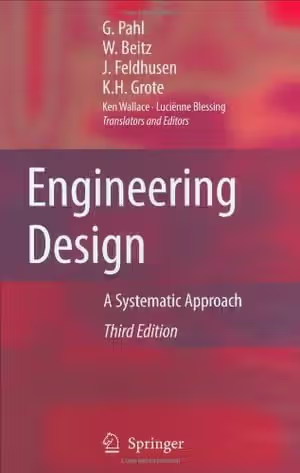
Pahl, G., Beitz, W., Feldhusen, J., & Grote, K.-H. (2007). Engineering Design: A Systematic Approach (3rd ed.). Springer.
Chapter Summary
The book runs to about 617 pages in twelve chapters. It is the English translation, by Ken Wallace and Luciënne Blessing, of the sixth German edition. The publisher describes its method as a design process broken down first into phases and then into distinct steps, each with its own working methods, to be applied flexibly and adapted to the task. Page spans below show where the weight lies: about 210 pages, more than a third of the book, belong to a single chapter on embodiment design.
Chapters 1–2: Introduction; Fundamentals
An opening chapter of about 25 pages is followed by a 35-page chapter titled "Fundamentals". The publisher's topic list puts fundamentals first, and the 2007 edition is described as emphasising fundamentals throughout rather than short-term trends.
Chapters 3–4: Product Planning, Solution Finding and Evaluation; Product Development Process
Chapter 3 (about 60 pages) joins product planning with the search for solutions and their evaluation. Chapter 4 is a short chapter on the product development process. The publisher lists, among the changes in this edition, an extended treatment of product planning and new sections on organisation structures, simultaneous engineering, leadership and team behaviour.
Chapters 5–6: Task Clarification; Conceptual Design
Task clarification (about 15 pages) precedes conceptual design (about 65 pages). The publisher groups the two under one topic: clarifying the task and then generating concepts. An MIT reviewer quoted by the publisher singles out the book's treatment of design from the functional perspective as a particular strength.
Chapter 7: Embodiment Design
The longest chapter by far, covering rules, principles and guidelines for embodiment design. The same reviewer points to the phase between conceptual and detail design as the part of the process where most key design decisions are made and as an especially strong section of the book. The publisher adds that this edition brings new examples and additions on design to minimise wear and design for recycling.
Chapters 8–9: Mechanical Connections, Mechatronics and Adaptronics; Size Ranges and Modular Products
Two specialised chapters follow. Chapter 8 deals with mechanical connections together with mechatronics and adaptronics, the latter two being additions highlighted for this edition. Chapter 9 treats size ranges and modular products.
Chapters 10–12: Design for Quality; Design for Minimum Cost; Summary
Quality methods and cost estimation methods are given a chapter each; the publisher says both were updated for this edition. A seven-page "Summary" closes the book.
Key Concepts
Chapters 1–6: Process and early phases
- Phases and steps: the design process is divided into phases, each broken into steps with their own working methods.
- Product planning: the early activity of deciding what to develop, given extended treatment in this edition.
- Task clarification: establishing what the design task requires before concepts are sought.
- Conceptual design: the phase in which solution concepts are generated and evaluated, approached from the functional perspective.
Chapters 7–12: Embodiment and supporting methods
- Embodiment design: giving a concept its physical form according to rules, principles and guidelines.
- Mechanical connections, mechatronics and adaptronics: specific design topics added or extended in this edition.
- Size ranges and modular products: the subject of Chapter 9.
- Quality methods and cost estimation: the two methods chapters that close the main text.
Critical Analysis
Strengths
- A complete path through the process. The chapter sequence runs from product planning and task clarification through conceptual and embodiment design to quality and cost, so a reader can see how each phase feeds the next. Warren Seering of MIT, quoted by the publisher, calls it the most complete available treatise on systematic design methods and notes that it documents each step and its associated practices.
- Depth where decisions are made. Embodiment design receives about a third of the book. Seering identifies the stretch between conceptual and detail design as the phase in which most key design decisions are made, and as a particularly strong part of the book.
- Updated for the third edition. The publisher lists extended product planning, organisation, simultaneous engineering and team behaviour, updated quality and cost chapters, and added material on wear, recycling, mechanical connections, mechatronics and adaptronics.
Limitations
- Length and density. At 617 pages, with the process chapters (3 to 7) occupying more than half of them, the book is a reference to be consulted by phase, not a short introduction.
- German-language sources. The reference lists on the chapter pages consist largely of German-language works, such as VDI guidelines, DIN standards and German journal articles, which an English-language reader cannot follow up easily.
- Scope. The listed topics concern method and the rules of embodiment, not the stress, fatigue and component calculations that machine-design textbooks handle. The material also reflects the state of practice in 2007.
Where It Fits in the Course
Within this design course, Nigel Cross's Engineering Design Methods is the concise guide to how designers work and which methods take a vague brief to a detailed proposal; it is the natural first read for the same ground at much shorter length, and Pahl and Beitz then supply the full procedure with its rules and guidelines. The component-oriented texts (Shigley's Mechanical Engineering Design, Norton's Machine Design, Fundamentals of Machine Component Design and Machine Elements in Mechanical Design) cover the loads, stresses, failure and sizing of elements such as shafts, bearings and gears. They answer the analytical questions that arise once a concept has been given form, and they complement rather than replace this book.
How to Use This Book
The publisher presents the book as a guide for practising designers, students and design educators. It is best approached with a grounding in machine elements and engineering mechanics and, ideally, some experience of a design project. Read Chapters 1 and 2 first, then follow the phases in order: Chapters 3 to 6 for planning, task clarification and concepts, and Chapter 7 for form. Treat Chapters 8 to 11 as topics to pick up when a project needs them (connections, modular product families, quality, cost), and use Chapter 12 as a recapitulation.
A practical approach is to read alongside a live or past project, applying one phase at a time. For the analytical side of embodiment, pair Chapter 7 with one of the component-design texts named above.