01 / Reading Guide
Reading Guide
Citation
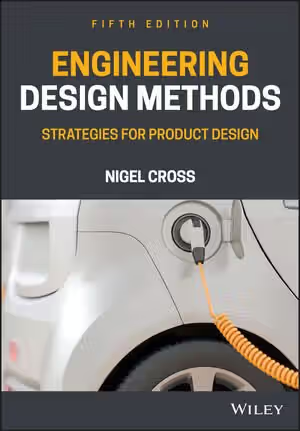
Cross, N. (2021). Engineering Design Methods: Strategies for Product Design (5th ed.). Wiley.
Chapter Summary
The fifth edition is a compact book of about 210 pages in three parts. Part One (Chapters 1–3) explains what design is and how the design process has been modelled. Part Two (Chapters 4–13) is the practical core: an introduction to design procedures, then eight chapters each built around one method, and a chapter on design strategy. Part Three (Chapter 14) places design in product planning and systems design. Wiley describes the book as written for undergraduates and postgraduates across engineering and product design. The author, Nigel Cross, is Emeritus Professor of Design Studies at the Open University and a former Professor of Design Methodology at Delft.
Chapter 1: The Activity of Design
The book opens with what designers say about their work, quoting engineering, industrial and furniture designers and the engineer-architect Santiago Calatrava on intuition, the interweaving of problem and solution, and sketching as a dialogue. It then works backwards from the end of designing: the essential output is a description of the artefact precise enough for others to make it. From there it moves through communication, evaluation, generation and exploration of designs. A new case study follows Gordon Murray's T.25 city car from notebook sketches through a wire-and-cardboard mock-up to a road-going prototype.
Chapters 2–3: The Nature of Design; The Process of Design
Chapter 2 examines design problems, how they are structured and how designers solve them. Chapter 3 compares descriptive, prescriptive and integrative models of the design process.
Chapter 4: Design Procedures
The bridge into practice: systematic procedures, the idea of design methods, and the two families the book uses, creative methods and rational methods.
Chapters 5–8: Identifying Opportunities; Clarifying Objectives; Establishing Functions; Setting Requirements
The first four method chapters cover problem definition. Each is built around a single method: the user scenarios method for finding product opportunities, the objectives tree method, the function analysis method and the performance specification method.
Chapters 9–12: Determining Characteristics; Generating Alternatives; Evaluating Alternatives; Improving Details
The next four methods carry a design from requirements to refined proposal: quality function deployment to turn customer requirements into engineering characteristics, the morphological chart for generating alternatives, the weighted objectives method for evaluating them, and the value engineering method for improving details.
Chapter 13: Design Strategies
What a design strategy is, frameworks for planning one, strategy control, and sections on learning to design and developing expertise, which correspond to the new material on design ability that Wiley highlights in this edition.
Chapter 14: Design and Innovation
The single chapter of Part Three looks beyond the individual project to product planning and systems design.
Key Concepts
Part One: Design fundamentals
- Design as description: the end product of designing is a description of the artefact, usually drawings, precise enough for others to make it.
- Co-evolution of problem and solution: designers develop problem and solution side by side, using tentative solutions to understand the problem.
- Descriptive and prescriptive models: accounts of how designers actually work versus recommendations for how they should.
Part Two: Design practice
- Creative and rational methods: methods that stimulate idea generation versus methods that structure the process systematically.
- Objectives tree: a hierarchy that clarifies design objectives and the relations between them.
- Function analysis: describing what a product must do as inputs, outputs and sub-functions, independent of any solution.
- Performance specification: stating requirements as measurable performance levels rather than as solutions.
- Quality function deployment: translating customer requirements into engineering characteristics.
- Morphological chart: a table of sub-functions and possible means, combined to generate alternative designs.
- Weighted objectives: scoring alternatives against weighted criteria to compare them.
- Value engineering: increasing the value of a design relative to its cost by examining components and details.
Part Three: Design thinking
- Design strategy and expertise: planning how a design project will proceed, and how design ability develops with experience.
- Product planning and systems design: design decisions at the level of a product range and of whole systems.
Critical Analysis
Strengths
- One method per chapter, with a clear procedure. Wiley highlights clear, detailed and illustrated presentations of eight key methods. The structure of Chapters 5–12 makes each method easy to find and to apply step by step, which suits students working on a live project.
- Grounded in research on designers. Chapter 1 draws on interviews with eminent designers and on observational studies to describe how designers think and work before any method is introduced. The fifth edition adds material on design thinking and design ability, reflecting the author's research field.
- A memorable real case. The Gordon Murray city-car study shows a complete development, from first sketches to a prize-winning prototype, and makes the process concrete from the start.
- Short and portable. At about 210 pages it can be read alongside a project module without displacing the technical textbooks.
Limitations
- Methods, not analysis. The book does not cover the engineering calculations that turn a concept into a working component. It has to be paired with analysis texts.
- Thin on later stages. The method chapters run up to value engineering. Detailed design for manufacture, testing and prototyping methods are not the subject of separate chapters, so students will need other sources for these stages.
- Breadth of Part Three. Innovation, product planning and systems design share one chapter, a short treatment of topics that have their own literatures.
Where It Fits in the Course
Cross is the design-process book in a mechanical design list otherwise built around machine elements. Mott, Vavrek and Wang's Machine Elements in Mechanical Design, Juvinall and Marshek's Fundamentals of Machine Component Design, Norton's Machine Design: An Integrated Approach and Budynas and Nisbett's Shigley's Mechanical Engineering Design all teach how to analyse and size shafts, gears, bearings, fasteners and other components. Cross addresses the earlier question of how to structure a design project and choose a concept. Read it at the start of a design module and return to the component texts once a concept has been chosen.
Pahl, Beitz, Feldhusen and Grote's Engineering Design: A Systematic Approach is the comprehensive reference on systematic design methodology. It treats the same phases (clarifying the task, function structures, conceptual and embodiment design) at much greater length and with mechanical examples. Cross is the natural introduction to it: students who find the function analysis and morphological chart chapters useful can follow the same ideas into Pahl and Beitz's fuller procedure.
How to Use This Book
Wiley addresses the book to undergraduates and postgraduates in all fields of engineering and product design. No technical background is needed, so it can be read in the first year, before any analysis course.
- Read first: Chapters 1–4, which explain the activity and process of design and introduce creative and rational methods. The city-car case in Chapter 1 is worth reading closely.
- Use with a project: Chapters 5–12 as a toolkit. Apply each method to your own brief as the project reaches that stage: user scenarios and objectives trees at the start, function analysis and performance specification while defining the problem, morphological charts and weighted objectives during concept selection, and value engineering during refinement.
- Read at the end: Chapter 13 on strategy and expertise, when you can reflect on how your own project went, and Chapter 14 for the wider product and systems context.
Keep the products of each method (objectives tree, function diagram, specification, morphological chart, evaluation table) together as a design file. Together they record the reasoning behind the final design and are useful in reports and design reviews.