01 / Reading Guide
Reading Guide
Citation
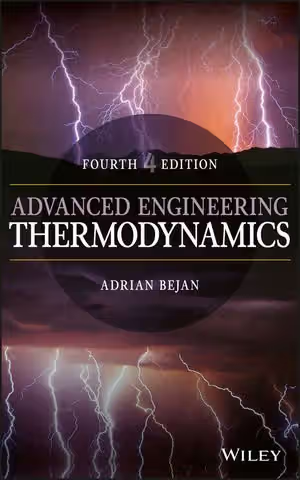
Bejan, A. (2016). Advanced Engineering Thermodynamics (4th ed.). Wiley.
Chapter Summary
The fourth edition has 13 chapters and a short appendix, in about 750 pages including a symbols list and an index. The publisher describes it as a treatment that goes beyond the basic coverage of most thermodynamics textbooks and links the first and second laws to engineering applications such as solar energy, refrigeration, air conditioning, thermofluid design, chemical design and constructal design. The first five chapters set out the laws, entropy generation and exergy; the middle chapters treat phases, reacting systems and power; and the later chapters apply the approach to refrigeration, entropy generation minimization, irreversible thermodynamics and the constructal law. Every chapter ends with a reference list and a set of problems.
Chapter 1: The First Law
Sections cover terminology, closed systems, work transfer, heat transfer, energy change, open systems and a history of the law. The opening section insists that the first step of any analysis is to define the system and its boundary unambiguously, and it shows that a wrongly chosen boundary hides the source of entropy generation. This is the "condensed" review of fundamentals the publisher mentions, written with an eye to what the later chapters need.
Chapter 2: The Second Law
Closed-system statements of the second law are developed through cycles in contact with one, two and any number of temperature reservoirs, followed by open systems, local equilibrium, and the entropy maximum and energy minimum principles. Two axiomatic treatments follow: Carathéodory's two axioms and a "heat transfer man's" two axioms. The chapter ends with a history section.
Chapter 3: Entropy Generation, or Exergy Destruction
The chapter links lost available work to entropy generation and applies the idea to heat engine, refrigeration and heat pump cycles and to nonflow and steady-flow processes. It then identifies mechanisms of entropy generation (heat transfer across a temperature difference, flow with friction and mixing) and introduces entropy generation minimization, including tree-shaped fluid flow and the entropy generation number.
Chapter 4: Single-Phase Systems
This chapter covers the simple system, equilibrium conditions, the fundamental relation (energy and entropy representations, the Euler equation, the Gibbs–Duhem relation), Legendre transforms, relations between thermodynamic properties (Maxwell's relations, Bridgman's table, Jacobians), partial molal properties and ideal and real gas mixtures.
Chapter 5: Exergy Analysis
Exergy analysis is set out for nonflow systems, flow systems and in generalized form, followed by a section on air conditioning (humid air, the exergy of liquid water and evaporative cooling).
Chapter 6: Multiphase Systems
The chapter begins with the energy minimum principle and its enthalpy, Helmholtz and Gibbs forms, then turns to the stability of a simple system, the continuity of the vapor and liquid states (including the van der Waals equation and Maxwell's equal-area rule), phase diagrams and the Gibbs phase rule, and corresponding states.
Chapter 7: Chemically Reactive Systems
Topics are chemical equilibrium, affinity and the Le Chatelier–Braun principle, irreversible reactions, steady-flow combustion (stoichiometry, first and second laws, maximum power output), the chemical exergy of fuels and combustion at constant volume.
Chapter 8: Power Generation
The chapter treats maximum power subject to size constraint and from a hot stream, external and internal irreversibilities, and advanced steam turbine, gas turbine and combined power plants.
Chapter 9: Solar Power
It starts with the thermodynamic properties of thermal radiation, then reversible and irreversible processes with radiation, the ideal conversion of enclosed blackbody radiation, maximization of power output per unit collector area, convectively cooled collectors, an extraterrestrial solar power plant, climate and self-pumping atmospheric circulation.
Chapter 10: Refrigeration
Coverage includes Joule–Thomson expansion, work-producing expansion, the Brayton cycle, intermediate cooling, liquefaction, refrigerator models with internal heat leak and magnetic refrigeration, ending with the third law.
Chapter 11: Entropy Generation Minimization
This chapter develops competing irreversibilities in heat transfer and fluid flow, balanced counterflow heat exchangers, storage systems, power maximization versus entropy generation minimization, and moves from entropy generation minimization to the constructal law.
Chapter 12: Irreversible Thermodynamics
The chapter covers conjugate fluxes and forces, linearized and reciprocity relations, thermoelectric phenomena (Peltier, Seebeck, Thomson), heat conduction in anisotropic media and mass diffusion.
Chapter 13: The Constructal Law
The last chapter formulates the constructal law and applies it to inanimate flow systems (such as river basins and turbulent flow structure) and animate ones (such as body heat loss, breathing and locomotion), then to economies of scale, growth and spreading, and the arrow of time. An appendix lists constants, mathematical formulas, variational calculus and property data for several states.
Key Concepts
Chapters 1–3: Laws and entropy generation
- System and boundary: defining the system unambiguously so that heat transfer and entropy transfer are conserved across the boundary.
- Entropy generation (exergy destruction): the measure of lost available work used throughout the book.
- Entropy generation minimization: a design method introduced in Chapter 3 and developed in Chapter 11.
Chapters 4–7: Properties, exergy, phases and reactions
- Fundamental relation and Legendre transforms: the formal basis for relations between properties.
- Exergy analysis: assessing flow and nonflow systems by available work.
- Stability and phase equilibrium: the energy minimum principle, the Gibbs phase rule and the van der Waals equation.
- Affinity and chemical exergy: the thermodynamics of reactions and fuels.
Chapters 8–13: Applications and extensions
- Maximum power under constraints: power generation limited by size and by irreversibilities.
- Irreversible thermodynamics: fluxes, forces and reciprocity.
- Constructal law: the proposition that flow systems evolve toward easier flow access.
Critical Analysis
Strengths
- Entropy generation as a continuing thread. Chapter 3 introduces entropy generation (exergy destruction) and Chapter 11 develops its minimization, while Chapters 5, 8 and 10 apply exergy and irreversibility to air conditioning, power plants and refrigeration, so the second law works as a design tool rather than only a statement.
- Care with fundamentals. The first section of Chapter 1 discusses the system, the boundary and the difference between properties and quantities such as work and heat, and Chapter 2 gives two axiomatic treatments of the second law and a historical section. These support readers who already know the basics and want to see why the framework is built as it is.
- Range of applications. The table of contents includes solar power, climate, refrigeration to magnetic refrigeration and the third law, combustion, thermoelectric effects and biological flow systems.
- Problems and references in every chapter. Each chapter closes with references and problems, and the publisher says the fourth edition adds worked problems and more homework problems.
Limitations
- Not a first course. The book assumes readers know basic thermodynamics. Chapter 1 is a condensed review, and the publisher describes the introductory chapters as a quick review before applications.
- A distinctive viewpoint. Chapters 11 and 13 develop the author's own entropy generation minimization and constructal law, and the publisher identifies the author as the originator of the constructal approach. Readers who want a neutral survey of every thermodynamic method will need other books.
- Selective coverage. The table of contents has no chapter on statistical thermodynamics, and the power-plant chapter is built around maximum power and "advanced" steam and gas turbine plants rather than the basic cycles of a first course.
- Size. At about 800 pages (the publisher's count), the book is larger than a one-semester course can cover, so an instructor or reader must choose chapters.
Where It Fits in the Course
Bejan is the advanced, second-course book of the thermodynamics list. Michael Moran and colleagues' Fundamentals of Engineering Thermodynamics, Claus Borgnakke and Richard Sonntag's Fundamentals of Thermodynamics, Yunus Cengel and colleagues' Thermodynamics: An Engineering Approach and Stephen Turns and Laura Pauley's Thermodynamics: Concepts and Applications are first-course engineering textbooks that build properties, the first and second laws, cycles and, in some cases, reacting systems. Peter Atkins's The Laws of Thermodynamics: A Very Short Introduction is a compact physical account of the four laws.
Read one of the textbooks first, because Bejan's Chapter 1 is only a compressed review. Turn to Bejan after the first course, when exergy, entropy generation and design for efficiency are the interest.
How to Use This Book
The book suits graduate students and advanced undergraduates in engineering who have already completed a thermodynamics course and are comfortable with calculus. It is also a reference for researchers on exergy, power cycles and heat-exchanger design.
A practical plan:
- Core: Chapters 1 to 3 for the laws and entropy generation, then Chapter 5 on exergy analysis.
- Choose by field: Chapters 4 and 6 for property relations and phase equilibrium; Chapter 7 for combustion and reacting systems; Chapters 8 to 10 for power and refrigeration.
- Design methods: Chapter 11 for entropy generation minimization and Chapter 13 for the constructal law, which can be read as a separate unit.
- Practice: Work the problems at the end of each chapter and use the History sections of Chapters 1 and 2 for context.