01 / Reading Guide
Reading Guide
Citation
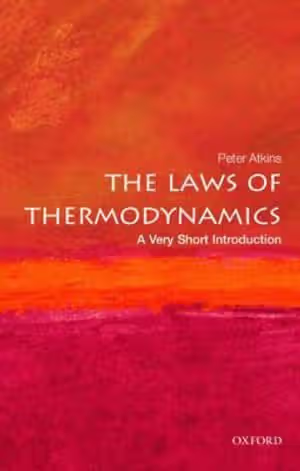
Atkins, P. (2010). The Laws of Thermodynamics: A Very Short Introduction. Oxford University Press.
Chapter Summary
The book is a pocket-sized paperback of about 128 pages in Oxford's Very Short Introductions series. After a preface come five chapters, a short conclusion and a further-reading list: one chapter for each of the four laws, plus a chapter on free energy between the second and third laws. An earlier edition appeared under the title Four Laws That Drive the Universe, and the publisher's description quotes reviews of it. The publisher describes the approach as accessible language with "virtually no mathematics", guiding the reader one step at a time, and the conclusion stresses that the molecular interpretation of the laws enriches the account built from bulk measurements.
Chapter 1: The zeroth law
The chapter starts with the law that two bodies each in thermal equilibrium with a third are in equilibrium with each other, and uses it to define temperature. On the way it sets out the vocabulary of thermodynamics (system, surroundings, equilibrium). It then turns to the molecular picture: the Boltzmann distribution, in which the population of a state falls off exponentially with its energy. A reviewer for the chemistry-teaching site ChemEdX notes that Atkins argues here that a parameter usually written β is a more natural measure of temperature than T itself.
Chapter 2: The first law
The first law extends the conservation of energy to heat and work, stated in terms of the internal energy of a closed system. The chapter introduces work, heat, internal energy, enthalpy, heat capacity and reversibility. Atkins opens by saying that, although this law is usually thought the easiest, it is more interesting than its summary suggests.
Chapter 3: The second law
The chapter introduces entropy, through the dissipation of energy and the operation of heat engines. It shows how an expression originally used for the efficiency of a steam engine leads to an absolute temperature scale defined in terms of work. The steam engine is the recurring image: Atkins presents the device that turns the dissipation of energy into organised motion as a model for processes as different as those in the human body.
Chapter 4: Free energy
Free energy is the part of a system's energy available to do work. The chapter defines the Helmholtz and Gibbs energies, links them to spontaneous change, and applies them to phase transitions, chemical equilibrium and biological processes such as the production of ATP for metabolism. The ChemEdX reviewer, a chemistry teacher, valued its more detailed treatment of a topic students find difficult.
Chapter 5: The third law
The last law concerns absolute zero and the attempt to approach it. As the ChemEdX review reports, Atkins notes that the third law is not of the same standing as the first three, since temperature, internal energy and entropy already carry the whole subject. The publisher describes the chapter as going to the brink of absolute zero and beyond it.
Conclusion
A short summing-up. The zeroth, first and second laws each introduce one property (temperature, internal energy and entropy); the first law limits which changes are possible, the second picks out those that are spontaneous, and the third brings the molecular and empirical accounts of thermodynamics together.
Key Concepts
Chapters 1–2: Temperature and energy
- Thermal equilibrium and temperature: the zeroth law makes temperature a well-defined property.
- Boltzmann distribution: the exponential fall in the population of molecular states with energy, which gives temperature a molecular meaning.
- Internal energy and enthalpy: the energy content of a system, and the related quantity convenient for processes at constant pressure.
- Reversibility: an idealised change that can be reversed by an infinitesimal adjustment, central to the later laws.
Chapters 3–4: Entropy and free energy
- Entropy: a measure of disorder, or of the quality of energy; the second law says it never decreases in an isolated system.
- Heat engines and efficiency: the steam-engine analysis from which the second law and the absolute temperature scale emerge.
- Helmholtz and Gibbs energy: the energy available for work, which decides whether a process at constant temperature can occur spontaneously.
Chapter 5: Absolute zero
- Absolute zero and the third law: the law concerning the lowest possible temperature and attempts to approach it, which Atkins treats as of a different standing from the first three.
Critical Analysis
Strengths
- Concepts before calculation. The book keeps mathematics to a minimum and spends its pages on what temperature, energy and entropy mean. Reviews of the earlier edition quoted by the publisher (in Nature, Science, Chemistry World and New Scientist) single out its clarity, its careful structure and its figures.
- Molecular and classical views together. From the Boltzmann distribution in Chapter 1 to the conclusion's point about the third law, the book keeps returning to how the bulk laws relate to the behaviour of molecules.
- A separate chapter on free energy. Giving the Helmholtz and Gibbs energies their own chapter, with chemical and biological examples, suits students who meet free energy in chemistry as well as engineering.
- An authoritative author. The publisher presents Atkins as a leading authority on thermodynamics, and the reviews it quotes stress the economy, precision and humour of the writing.
Limitations
- Not an engineering textbook. Neither the contents nor the reviews point to property tables, control-volume analysis or exercises; the book explains ideas but does not teach the problem-solving that an engineering thermodynamics course examines.
- A chemist's emphasis. The examples in the free-energy chapter come from chemistry and biology rather than from power plants or refrigeration.
- Very short. With about 128 small pages, each chapter runs to only fifteen to twenty-five pages, enough to explain an idea but not to develop it.
Where It Fits in the Course
Atkins is the conceptual companion in the thermodynamics list, the only book in it that aims at understanding the laws rather than applying them to engineering systems. Turns and Pauley's Thermodynamics: Concepts and Applications is the introductory engineering textbook in the list: reading Atkins's Chapters 1–3 before or alongside its opening chapters gives a clear picture of what temperature, energy and entropy are before the methods for energy and entropy analysis arrive. The same applies to the longer standard engineering textbooks, Çengel, Boles and Kanoglu's Thermodynamics: An Engineering Approach, Borgnakke and Sonntag's Fundamentals of Thermodynamics and Moran, Shapiro, Boettner and Bailey's Fundamentals of Engineering Thermodynamics, any of which can serve as the main course text. Bejan's Advanced Engineering Thermodynamics is a graduate book that uses the first and second laws as design tools, far beyond this introduction.
How to Use This Book
The book suits first-year engineering, physics and chemistry students starting thermodynamics, and anyone who has passed a thermodynamics course without feeling they understood entropy. School science is enough, and the few equations are explained in words.
- Before the course or in its first weeks: read Chapters 1–3 in order. They take only a few evenings and give a framework for the definitions an engineering textbook introduces more formally.
- When the course reaches entropy and the second law: reread Chapter 3, paying attention to how the steam-engine argument leads to entropy and to the absolute temperature scale.
- For chemistry-related modules: Chapter 4 on free energy is the most useful chapter for chemical equilibrium and phase changes.
- Optional: Chapter 5 and the conclusion round off the picture and are worth reading once.
Use the book as a companion rather than a substitute: practise the calculations in the main textbook, and come back to Atkins whenever a definition seems to have lost its physical meaning. The further-reading list points to longer treatments for those who want more.