01 / Reading Guide
Reading Guide
Citation
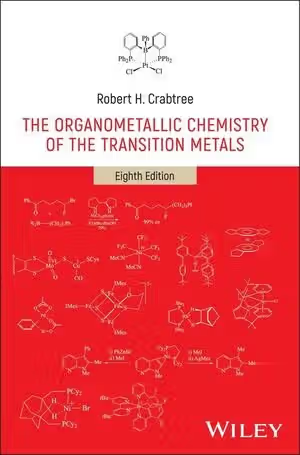
Crabtree, R. H. (2026). The Organometallic Chemistry of the Transition Metals (8th ed.). Wiley.
Chapter Summary
The eighth edition has sixteen chapters and about 575 pages, with two appendixes (useful texts on allied topics; major reaction types), answers to problems, and an index. Every chapter ends with references and problems. The first five chapters build the vocabulary of bonding, electron counting and ligands; Chapters 6–8 cover the fundamental reaction types; Chapters 9–10 turn to catalysis and to the physical methods used to study mechanisms; and Chapters 11–16 treat further classes of compounds and the applications of the field. The chapter opens by placing organometallic chemistry between organic and inorganic chemistry, and by focusing on the d-block metals, where metal d orbitals open reaction pathways that main-group organometallics lack.
Chapter 1: Introduction
Sets out why the subject matters (Section 1.1) and reviews the coordination chemistry on which it rests: Werner complexes, the trans effect, soft versus hard ligands and metals, the crystal field and ligand field, two-electron three-center bonding, back bonding, the choice of metals, and the sd^n model with hypervalent bonding.
Chapter 2: Making Sense of Organometallics
The organising tools of the subject: valence electron counting, the 18-electron "rule" and its limitations, electron counting for common ligands, bridging and zero-electron ligands, electron counting in reactions, the oxidation-state concept and its limits, coordination number and geometry, the effects of complexation on ligands, differences between metals, ligand types, and noninnocent ligands.
Chapter 3: Alkyls, Aryls, and Hydrides
Stability and synthesis of metal alkyls and aryls, other σ-bonded ligands, metal hydrides, sigma complexes, and metal–ligand bond strengths.
Chapter 4: Ligands and Substitution
Metal carbonyls (structure, bonding, synthesis, reactivity, bridging and CO analogues), nitrosyls, phosphines and related donors, N-heterocyclic carbenes; then dissociative, associative, redox-assisted and photochemical substitution, other factors in substitution, and metal–ligand cooperativity.
Chapter 5: Pi-Complexes
Alkene and alkyne, allyl, diene, cyclopentadienyl and arene complexes, metallacycles, the polyene versus polyenyl distinction, and perfluorocarbon ligands.
Chapters 6–8: Oxidative Addition and Reductive Elimination; Insertion and Elimination; Addition and Abstraction
The fundamental reaction types. Chapter 6 treats the mechanisms of oxidative addition (concerted, SN2, radical, ionic) and reductive elimination, with sigma bond metathesis and oxidative coupling. Chapter 7 covers 1,1- and 1,2-insertion, outer-sphere insertions, beta elimination, alkene isomerization catalysis and hydrogen-borrowing catalysis. Chapter 8 covers nucleophilic and electrophilic addition and abstraction, the Wacker process, electron transfer and radical pathways, and proton-coupled electron transfer.
Chapter 9: Homogeneous Catalysis
Catalytic cycles, then hydrogenation, hydroformylation, hydrocyanation, hydrosilylation, cross-coupling, oxidation catalysis, electrocatalysis, photoredox catalysis, and catalyst decomposition and deactivation.
Chapter 10: Physical Methods
Mechanism, ¹H/²H, ¹³C and ³¹P NMR, dynamic NMR, EPR, IR spectroscopy, structure determination, electrochemistry, computation, big data, artificial intelligence and machine learning, and other methods.
Chapters 11–12: Carbenes, Carbynes, and M–L Multiple Bonding; Metathesis, Polymerization, and Bond Activation
Chapter 11 covers carbenes, carbynes, bridging carbenes and carbynes, N-heterocyclic carbenes, carbide and carbone complexes, and multiple bonds to heteroatoms. Chapter 12 covers alkene metathesis, dimerization, oligomerization and polymerization, activation of CO and CO2, and C–H activation and functionalization.
Chapters 13–14: Green, Energy & Materials Applications; Organic Applications
Chapter 13 treats green chemistry, alternative energy, metal–metal bonds and clusters, nanoparticles, organometallic materials and supported organometallics. Chapter 14 surveys uses in organic synthesis: coupling, C–H activation and late-stage functionalization, metathesis, carbenes in cyclopropanation, hydrogenation, oxidation, carbonylation, photoredox catalysis, alkyne and aryne chemistry, radical chemistry, hydroboration, electrosynthesis and isotope exchange.
Chapters 15–16: High Oxidation States, Magnetism, and the f-Block; Bioorganometallic Chemistry
Chapter 15 covers high oxidation states, magnetism and spin states, cyclopentadienyl complexes and the f-block. Chapter 16 covers coenzyme B12, iron–sulfur clusters, nitrogen fixation, nickel enzymes, and applications in chemical biology and biomedicine.
Key Concepts
Chapters 1–5
- 18-electron rule: the electron count that guides which complexes are stable, with its stated limitations.
- Oxidation-state concept: how metal oxidation states are assigned, and where the formalism breaks down.
- Back bonding: donation from metal d orbitals to ligand orbitals, central to carbonyl and alkene complexes.
- Ligand substitution: dissociative, associative and photochemical pathways.
Chapters 6–10
- Oxidative addition and reductive elimination: paired reactions that change the metal's oxidation state and electron count.
- Insertion and beta elimination: bond-forming and bond-breaking steps at the metal.
- Catalytic cycles: the sequences of elementary steps that make up catalysis.
Chapters 11–16
- Carbenes and metathesis: metal–carbon multiple bonds and the reaction that exchanges alkene fragments.
- C–H activation: functionalising C–H bonds with metal complexes.
- Bioorganometallic systems: organometallic species in biology.
Critical Analysis
Strengths
- Principles before reactions before applications. Bonding and counting rules come first, then the fundamental reaction types, then catalysis and applications; the contents show each chapter building on earlier ones.
- Applications are covered at length. Chapters 9, 13 and 14 deal with homogeneous catalysis, green chemistry, energy, materials and organic synthesis, and Chapter 16 with bioorganometallic chemistry.
- Current content. The publisher reports that the eighth edition replaces older citations with recent ones, and adds material on electro- and photocatalysis, computational studies, radical pathways, spin-state effects, molecular electronics, proton-coupled electron transfer, X-ray techniques and alternative energy; the contents list a section on big data and machine learning.
- Study material. Each chapter has references and problems, and the book provides answers.
Limitations
- Selective coverage. The author states that the field has grown so far that the book can only sample it, drawing characteristic examples for close study; it is not a catalogue of the subject.
- Main-group organometallics are left out. The introduction explains that main-group reagents are treated in organic chemistry texts, so this book concentrates on the transition metals.
- Demanding background. Chapter 1 condenses the coordination chemistry that the later chapters assume into a single chapter, and the book then moves quickly into electron counting, mechanism and catalysis.
Where It Fits in the Course
In the inorganic chemistry course this is the specialist text on metal–carbon compounds. The general inorganic textbooks come first: the comprehensive Inorganic Chemistry by Shriver, Weller, Overton and colleagues covers atomic structure, bonding, main-group and transition-metal chemistry, Housecroft's Inorganic Chemistry combines physical-inorganic principles with descriptive chemistry, and Rayner-Canham and Overton's Descriptive Inorganic Chemistry surveys the elements group by group. Pfennig's Principles of Inorganic Chemistry is a concept-focused text that develops symmetry and group theory with molecular-orbital models; its closing chapters on coordination and organometallic chemistry are a first look at what Crabtree takes much further. Scerri's The Periodic Table: A Very Short Introduction is a short orientation book.
Crabtree is the book to read after a course in coordination chemistry and in preparation for research in catalysis, organic synthesis or materials.
How to Use This Book
The book is aimed at advanced undergraduate and graduate students in organic, organometallic, inorganic and bioinorganic chemistry, and at practising chemists in related fields. Undergraduate inorganic and organic chemistry, including crystal-field and molecular-orbital descriptions of complexes, should be in place.
A practical plan:
- Core: Chapters 1–2 (electron counting and the vocabulary), then Chapters 3–8 for ligands and the fundamental reactions. These are the chapters on which everything else depends.
- Catalysis and methods: Chapter 9 for catalytic cycles and Chapter 10 for the spectroscopic methods used to establish mechanisms.
- Choose by interest: Chapters 11–12 (carbenes, metathesis, polymerization, bond activation), Chapter 14 for organic synthesis, Chapter 13 for green chemistry and materials, Chapters 15–16 for f-block and biological topics.
- Use the problems and references at the end of each chapter, and Appendix B on major reaction types as a summary.