01 / Reading Guide
Reading Guide
Citation
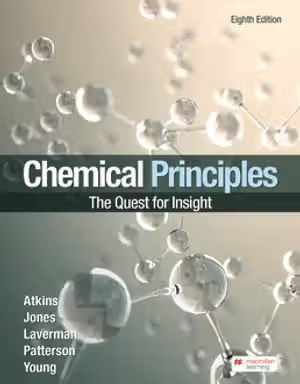
Atkins, P., Jones, L., Laverman, L., Young, K., & Patterson, J. (2023). Chemical Principles: The Quest for Insight (8th ed.). W. H. Freeman (Macmillan Learning).
Chapter Summary
The eighth edition has 1,120 pages and two new coauthors, Kelley Young and James Patterson. Rather than numbered chapters in the usual sequence, the book is organized as an opening Fundamentals section followed by ten "Focus" units, each divided into short lettered topics (1A, 1B and so on). The publisher also lists seven "Major Techniques" that are available online only.
Fundamentals: Introduction and orientation; Topics A–M
This section reviews the basics so that the Focus units can start from a common footing: matter and energy; elements and atoms; compounds; nomenclature; moles and molar masses; the determination of composition; mixtures and solutions; chemical equations; precipitation reactions; acids and bases; redox reactions; reaction stoichiometry; and limiting reactants. The publisher notes that an online Fundamentals Diagnostic Test accompanies it.
Focus 1: Atoms
Six topics build the atom from the evidence for its structure: investigating atoms, quantum theory, wavefunctions and energy levels, the hydrogen atom, many-electron atoms, and periodicity.
Focus 2: Bonds Between Atoms
Seven topics cover ionic bonding, covalent bonding, going beyond the octet rule, the properties of bonds, the VSEPR model, valence-bond theory and molecular orbital theory.
Focus 3: States of Matter
Seven topics cover the nature of gases, the gas laws in action, gases in mixtures and reactions, intermolecular forces, real gases, liquids and solids.
Focus 4: Thermodynamics
Ten topics run from internal energy, work and heat, enthalpy and thermochemistry, through contributions to enthalpy, to entropy (including its molecular interpretation, absolute entropies and global changes in entropy) and Gibbs free energy.
Focus 5: Equilibrium
Nine topics treat vapor pressure, phase equilibria of one- and two-component systems, solubility, colligative properties, chemical equilibrium, alternative forms of the equilibrium constant, equilibrium calculations and the response of equilibria to changing conditions.
Focus 6: Reactions
The largest unit has fifteen topics. The first part covers acids and bases: their nature, autoprotolysis and pH, weak acids and bases, the pH of aqueous solutions, polyprotic acids, very dilute solutions, buffers and titrations, followed by solubility equilibria and precipitation. The remainder covers electrochemistry: representing redox reactions, galvanic cells, standard potentials, applications of electrode potentials and electrolysis.
Focus 7: Kinetics
Five topics cover reaction rates, integrated rate laws, reaction mechanisms, models of reactions and catalysis.
Focus 8: Materials
Thirteen topics survey descriptive inorganic chemistry: periodic trends, hydrogen, the alkali and alkaline earth metals, the groups 13 to 18 (boron, carbon, nitrogen, oxygen families, halogens and noble gases), a survey of the d-block, coordination compounds and the electronic structure of d-metal complexes. According to the publisher, the eighth edition merged two earlier foci into this one and folded in topics on inorganic materials and materials for new technologies.
Nuclear Chemistry and Organic Chemistry
The final two units are the smallest. Nuclear chemistry has three topics: nuclear decay, radioactivity and nuclear energy. Organic chemistry has five: structures of aliphatic hydrocarbons, reactions of aliphatic hydrocarbons, aromatic compounds, common functional groups, and polymers and biological macromolecules.
Major Techniques (online only)
Seven treatments are listed: infrared and microwave spectroscopy, ultraviolet and visible spectroscopy, X-ray diffraction, chromatography, mass spectrometry, nuclear magnetic resonance and computation.
Key Concepts
Fundamentals and Foci 1–3
- Quantum description of the atom: wavefunctions and energy levels underpin the treatment of the hydrogen atom, many-electron atoms and periodicity.
- Bonding models: ionic and covalent bonding, the VSEPR model, valence-bond theory and molecular orbital theory.
- States of matter: gases and their laws, intermolecular forces, liquids and solids.
Foci 4–7
- Entropy and Gibbs free energy: the molecular interpretation of entropy and the criterion of spontaneous change.
- Chemical equilibrium: the equilibrium constant and how equilibria respond to changes in conditions.
- Electrochemical cells and standard potentials: cell reactions, standard potentials and their applications.
- Rate laws and mechanisms: integrated rate laws, mechanisms and catalysis.
Foci 8 onward
- Periodic trends and group chemistry: the systematic description of the elements.
- Coordination compounds: complexes and the electronic structure of d-metal complexes.
- Nuclear decay and organic structure: radioactivity, hydrocarbons, functional groups and polymers.
Critical Analysis
Strengths
- A principles-first sequence. Atoms and bonding come before thermodynamics, equilibrium, reactions and kinetics, and descriptive chemistry follows, so the later topics can lean on the earlier models.
- Support for different starting points. The Fundamentals section with its diagnostic test gives readers a way to check and repair their basics before the Focus units begin.
- Study resources. The publisher lists a student solutions manual with worked solutions for every odd-numbered exercise and for the Fundamentals exercises, in-class worksheets for every focus, and application icons marking links to forensic science, green and environmental chemistry, astronomy, technology, biology and medicine, and engineering. The Achieve online system supplies homework problems with hints and feedback.
- Short topics. About ninety lettered topics make it easy for an instructor or reader to select and reorder material.
Limitations
- Length. At 1,120 pages the book is large, and the short-topic structure means a reader must decide what to skip.
- Techniques online only. The seven Major Techniques, including NMR, mass spectrometry and X-ray diffraction, are not in the printed book.
- Late and brief organic and nuclear coverage. Organic chemistry is a five-topic unit near the end, covering hydrocarbons, functional groups and polymers; its topic list has no separate treatment of reaction mechanisms, so organic chemistry needs its own text.
Where It Fits in the Course
Within the general chemistry course, Atkins is aimed at readers who want the reasons behind the rules. Chemistry 2e is a free, openly licensed two-semester text suited to independent study, Chemistry: The Central Science is a two-semester text built around clear explanations and extensive problem practice, and Petrucci and colleagues' General Chemistry emphasizes problem-solving and applications. Any of these works as a first pass; Atkins is the choice when the aim is a more principles-oriented sequence.
Keeler and Wothers's Chemical Structure and Reactivity takes a different route: it sets aside the usual organic, inorganic and physical divisions and builds on molecular orbital theory, thermodynamics and kinetics to explain both organic and inorganic compounds. It works well as a second book for a reader who has finished Atkins's treatment of bonding, thermodynamics and kinetics and wants them applied across the whole of chemistry.
How to Use This Book
The book suits students in first-year chemistry courses that want more depth, and readers who have completed a general chemistry course and want a more principled treatment before physical chemistry. Start with the Fundamentals diagnostic test; if it shows gaps, work through the relevant topics A to M before moving on.
A practical plan:
- Core: Foci 1 to 7 in order. Foci 1 and 2 (atoms and bonding) feed directly into Foci 4 and 5, and kinetics in Focus 7 can be read right after equilibrium.
- Selective: Focus 3 (states of matter) can be read earlier for gas-law-heavy courses; the electrochemistry topics in Focus 6 pair with the thermodynamics of Focus 4.
- Reference and survey: Focus 8 (materials), nuclear chemistry and organic chemistry, as time or the syllabus allows.
- Techniques: the online Major Techniques as companions to laboratory work.
After each topic, work the exercises, and use the odd-numbered solutions in the student solutions manual to check method as well as answers.