01 / Reading Guide
Reading Guide
Citation
Bird, R. B., Stewart, W. E., Lightfoot, E. N., & Klingenberg, D. J. (2014). Introductory Transport Phenomena. Wiley.
Chapter Summary
The book is an undergraduate adaptation of Bird, Stewart and Lightfoot's Transport Phenomena, the long-standing graduate text, prepared with Daniel Klingenberg. It runs to about 780 pages: an introductory Chapter 0, then three parts on momentum, energy and mass transport (24 numbered chapters in all), a postface, and five appendices on vector and tensor notation, the fluxes and equations of change, mathematical topics, tables for predicting transport properties, and constants and conversion factors. A summary of flux expressions is printed at the front. The publisher says the organization follows the parent text but the presentation has been revised for students meeting the subject for the first time, with fuller step-by-step derivations. Each chapter ends with a summary and discussion questions intended for "flipped classroom" use. The three parts are built in parallel: the same sequence of chapter types recurs for each kind of transport, which is the clearest way to read the contents below.
Chapter 0: The Subject of Transport Phenomena
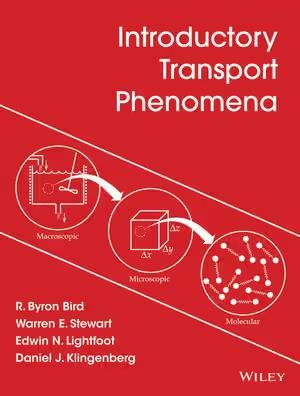
An introductory chapter that sets out what the subject covers before the three parts begin. The publisher's description of the book's approach applies here: momentum, energy and mass transport are treated together, and each can be studied at the molecular, microscopic and macroscopic levels.
Part I, Chapters 1–3: Viscosity and the Mechanisms of Momentum Transport; Shell Momentum Balances and Velocity Distributions in Laminar Flow; The Equations of Change for Isothermal Systems
The molecular level comes first, with viscosity as the transport property for momentum. Shell balances then give velocity profiles in simple laminar flows, and Chapter 3 generalizes these into the equations of change for isothermal systems.
Part I, Chapters 4–8: Velocity Distributions in Turbulent Flow; Dimensional Analysis for Isothermal Systems; Interphase Transport in Isothermal Systems; Macroscopic Balances for Isothermal Flow Systems; Non-Newtonian Liquids
The remaining momentum chapters extend the treatment to turbulence, use dimensional analysis to organize results, move to transport between phases, and finish at the macroscopic level with balances over whole flow systems. Chapter 8, on non-Newtonian liquids, has no counterpart in the energy and mass parts.
Part II, Chapters 9–16: Thermal Conductivity and the Mechanisms of Energy Transport; Shell Energy Balances and Temperature Distributions in Solids and Laminar Flow; The Equations of Change for Nonisothermal Systems; Temperature Distributions in Turbulent Flow; Dimensional Analysis in Nonisothermal Systems; Interphase Transport in Nonisothermal Systems; Macroscopic Balances for Nonisothermal Systems; Energy Transport by Radiation
Part II repeats the momentum sequence for heat: thermal conductivity, shell energy balances in solids and laminar flow, the nonisothermal equations of change, turbulence, dimensional analysis, interphase transport and macroscopic balances. Radiation takes the place of the non-Newtonian chapter as the energy part's extra topic.
Part III, Chapters 17–24: Diffusivity and the Mechanisms of Mass Transport; Concentration Distributions in Solids and in Laminar Flow; The Equations of Change for Binary Mixtures; Concentration Distributions in Turbulent Flow; Dimensional Analysis for Flowing Mixtures; Interphase Transport in Nonisothermal Mixtures; Macroscopic Balances for Multicomponent Systems; Other Mechanisms for Mass Transport
Part III follows the same path for chemical species: diffusivity, concentration profiles from shell balances, the equations of change for binary mixtures, turbulence, dimensional analysis, interphase transport and macroscopic balances for multicomponent systems. The final chapter covers mass transport by mechanisms other than ordinary diffusion. A postface closes the main text.
Key Concepts
Chapter 0 and the overall plan
- Analogy among the three transports: momentum, energy and mass are developed in parallel, so the similarities and differences between their conservation equations and transport coefficients stand out.
- Three levels of description: molecular (transport properties), microscopic (equations of change) and macroscopic (balances over whole systems).
Part I: Momentum Transport
- Viscosity: the transport property linking momentum flux to velocity gradients.
- Shell balance: a balance over a thin region that yields velocity profiles for simple laminar flows.
- Equations of change: general differential equations for isothermal flow, with fluxes and equations collected in Appendix B.
- Non-Newtonian liquids: fluids whose viscous behaviour does not follow Newton's law of viscosity.
Part II: Energy Transport
- Thermal conductivity: the transport property for conductive heat flux.
- Interphase transport: heat exchange between phases, organized by dimensional analysis.
- Radiation: energy transport that does not need a material medium.
Part III: Mass Transport
- Diffusivity: the transport property for molecular mass flux in mixtures.
- Binary mixtures: the equations of change for two-component systems.
- Macroscopic balances for multicomponent systems: balances over whole equipment or organs for several species.
Critical Analysis
Strengths
- A unified treatment. The parallel structure of the three parts lets each new part reuse the methods of the previous one, and the publisher emphasizes the comparison between the three sets of conservation equations and transport coefficients. A review in TCE (The Chemical Engineer, May 2015) by José Carlos Magalhães Pires, quoted by Wiley, called it one of the most complete books on the subject and noted that few books cover all three transports in such depth.
- Derivations made accessible. According to the publisher, more space is given to mathematical derivations than in the parent text, with step-by-step explanations and an appendix of mathematical topics, alongside an appendix on vector and tensor notation.
- Teaching aids. Chapter summaries and discussion questions suit flipped classes, the flux summary at the front and Appendix B serve as reference, and Wiley provides student and instructor companion sites.
- A path to the classic text. Because the organization follows Transport Phenomena, students who later need the graduate version will find the same structure and notation.
Limitations
- A general engineering text. The chapter titles show no biological or medical applications. In a biotransport course, the physiological context (blood flow, membranes, oxygen transport, devices) must come from other books.
- Long and mathematical. At about 780 pages, with an appendix devoted to vector and tensor notation, the book holds more than a one-semester course can cover, and it assumes comfort with differential equations.
- Some topics in one chapter only. Non-Newtonian behaviour, radiation and the "other mechanisms" of mass transport each get a single chapter, so they are introductions rather than full treatments.
Where It Fits in the Course
In this course the book provides the general physics of transport, while the other books apply it to living systems. Rubenstein, Yin and Frame's Biofluid Mechanics is an introductory text that teaches fluid mechanics through the circulation and needs no previous fluids course; it is a gentler entry to the material of Part I. Fournier's Basic Transport Phenomena in Biomedical Engineering and Roselli and Diller's Biotransport: Principles and Applications cover momentum, heat and mass transport with physiological and device examples throughout; Roselli and Diller even share the macroscopic, shell-balance and microscopic progression. Students who learn the methods from Bird and colleagues can move to either for applications, or use one of them as the main text and this book as the reference for derivations.
Truskey, Yuan and Katz's Transport Phenomena in Biological Systems links transport theory with physiology, including diffusion with reaction and electrokinetic processes, and suits a more advanced course after this one. Friedman's Principles and Models of Biological Transport is a graduate text on transport across membranes and epithelia, a subject this book does not address.
How to Use This Book
The book is for undergraduates in chemical, mechanical or biomedical engineering taking a first transport course. Readers need calculus through differential equations and basic physics; Appendices A and C supply the vector and tensor notation and the mathematical topics, and are worth reading early.
A practical plan:
- Start: Chapter 0, then Chapters 1–3, working through the shell-balance examples by hand. These chapters set the method for the rest of the book.
- Core for a biotransport course: Chapters 9–11 and 17–19, the molecular, shell-balance and equations-of-change chapters for heat and mass, read side by side with Chapters 1–3 to see the analogy.
- Next: the interphase transport and macroscopic balance chapters (6–7, 14–15, 22–23), which connect the theory to equipment and organ-level problems.
- Optional: turbulence (4, 12, 20), non-Newtonian liquids (8), radiation (16) and other mass transport mechanisms (24), chosen according to the course.
Use the chapter summaries and discussion questions to check understanding before working problems, and pair each part with the corresponding biological chapters of Fournier, Roselli and Diller, or Truskey, Yuan and Katz.