01 / Reading Guide
Reading Guide
Citation
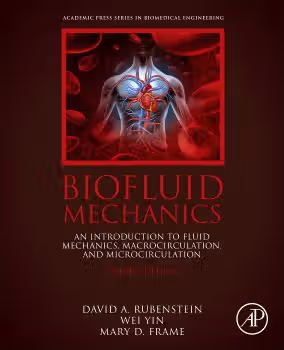
Rubenstein, D. A., Yin, W., & Frame, M. D. (2021). Biofluid Mechanics: An Introduction to Fluid Mechanics, Macrocirculation, and Microcirculation (3rd ed.). Academic Press.
Chapter Summary
The third edition has 17 chapters in five parts, running to a little over 600 pages, by three biomedical engineering faculty at Stony Brook University whose research concerns blood flow, platelets, endothelial cells and the microcirculation. Elsevier describes the book as applying fluid mechanics principles not only to blood circulation but also to air flow in the lungs, joint lubrication, intraocular fluid, renal transport and other specialty circulations. According to the publisher, this edition adds homework problems and worked examples, including MATLAB-based examples, new material on Womersley and oscillatory flows, and markers that identify the more advanced topics so that instructors can skip them in an undergraduate course. Page ranges below are from the publisher's chapter records.
Part 1: Fluid Mechanics Basics (Chapters 1–4: Introduction; Fundamentals of Fluid Mechanics; Conservation Laws; Introduction to Heat Transfer)
The first part teaches the engineering background before any physiology is applied to it. Chapter 2 (about 55 pages) covers the fundamentals of fluid mechanics, and Chapter 3, at about 60 pages one of the longest in the book, develops the conservation laws. Chapter 4 adds an introduction to heat transfer, which is used again with mass transport in the microcirculation.
Part 2: Macrocirculation (Chapters 5–6: The Heart; Blood Flow in Arteries and Veins)
Two long chapters apply the basics to the large-scale circulation: the heart (about 50 pages) and flow in arteries and veins (about 80 pages, the longest chapter). Womersley and oscillatory flow, which the publisher lists as new topics in this edition, are the standard models for the pulsatile flow found in the heart and large arteries.
Part 3: Microcirculation (Chapters 7–9: Microvascular Beds; Mass Transport and Heat Transfer in the Microcirculation; The Lymphatic System)
Three chapters on small vessels: the structure and flow of microvascular beds, the exchange of mass and heat between blood and tissue, and the lymphatic system that returns fluid to the circulation.
Part 4: Specialty Circulations (Chapters 10–14: Ventilation/Perfusion in the Lung; Intraocular Fluid Flow; Lubrication of Joints and Transport in Bone; Flow Through the Kidney; Splanchnic Circulation: Liver and Spleen)
Five shorter chapters, each 15–40 pages, carry the methods beyond blood vessels: air flow and perfusion in the lung, fluid in the eye, synovial lubrication and transport in bone, renal flow and the circulation of the liver and spleen. (The publisher's chapter records title Chapter 10 more briefly as "Flow in the Lungs".)
Part 5: Modeling and Experimental Techniques (Chapters 15–17: In silico, In vitro and In vivo Biofluid Mechanics)
The book ends with three chapters on how biofluid problems are studied in practice: computational modelling, laboratory experiments and measurements in living systems.
Key Concepts
Part 1: Fluid Mechanics Basics
- Fluid mechanics fundamentals: the properties and behaviour of fluids that the rest of the book applies to the body.
- Conservation laws: the balances of mass, momentum and energy from which flow problems are solved.
- Heat transfer: the movement of thermal energy, introduced alongside fluid flow.
Parts 2–3: Macrocirculation and Microcirculation
- Macrocirculation: flow in the heart and large vessels.
- Womersley and oscillatory flow: models of pulsatile flow, listed by the publisher as new in the third edition.
- Microcirculation: flow in small vessels, where exchange between blood and tissue takes place.
- Mass and heat transport in the microcirculation: how substances and heat move between blood and the surrounding tissue.
- Lymphatic system: the vessels that return interstitial fluid to the blood.
Parts 4–5: Specialty Circulations and Methods
- Specialty circulations: fluid flow in the lung, eye, joints and bone, kidney, liver and spleen.
- In silico, in vitro and in vivo methods: computation, laboratory models and measurement in living systems as complementary ways of studying biofluid mechanics.
Critical Analysis
Strengths
- Self-contained foundations. A full part (four chapters, about 150 pages) teaches fluid mechanics, conservation laws and heat transfer before any physiology is applied. The publisher stresses language and mathematics suited to undergraduates and first-year graduate students, so students without a prior fluids course can start here.
- Breadth beyond the cardiovascular system. Part 4 gives separate chapters to the lung, eye, joints and bone, kidney, and liver and spleen, coverage the publisher points to as going beyond the traditional biofluids curriculum. Clinical applications are, in the publisher's description, discussed throughout.
- Methods as well as results. Part 5 closes with computational, laboratory and in vivo approaches, a useful bridge to research projects.
- Teaching support in the third edition. New worked examples and end-of-chapter problems, MATLAB-based examples, and marked advanced topics that can be omitted without losing continuity.
Limitations
- Pitched higher than a first course. The publisher names senior undergraduates and graduate students in biomedical and mechanical engineering as readers and calls the book particularly suitable for senior and graduate courses. Early undergraduates will need to skip the marked advanced topics, and the book's length (over 600 pages) means a single course covers only part of it.
- Short treatment of specialty circulations. Each chapter in Part 4 runs to between 15 and 40 pages, so these are introductions to each system rather than full treatments.
- Fluid-centred. The book covers mass and heat transfer mainly within the microcirculation; students who need a general treatment of diffusion, reaction and membrane transport will need a dedicated transport text.
Where It Fits in the Course
Within a biotransport course this book is the fluids-first, physiology-organised option. Bird, Stewart, Lightfoot and Klingenberg's Introductory Transport Phenomena is a first course in transport that develops momentum, heat and mass transfer in parallel through general balances, with no special focus on the body; it pairs well with this book for students who want the general theory behind Part 1. Fournier's Basic Transport Phenomena in Biomedical Engineering applies flow, mass transfer and thermodynamics to physiology and devices such as dialysers and oxygenators, giving more weight to mass transfer than this book does.
Roselli and Diller's Biotransport: Principles and Applications treats momentum, heat and mass transport with one consistent method from macroscopic balances to general equations, and suits students who want a more systematic transport course after or alongside this book. Truskey, Yuan and Katz's Transport Phenomena in Biological Systems and Friedman's Principles and Models of Biological Transport are more advanced: the first links transport theory and physiology across flow, diffusion, reaction and electrokinetics, the second concentrates on transport across membranes and epithelia. Read Rubenstein, Yin and Frame first if blood flow and organ-level circulation are the main interest.
How to Use This Book
The book suits biomedical and mechanical engineering students in the later undergraduate years and beginning graduate students, and readers who want to study blood flow and other physiological flows without having taken a separate fluids course. Readers should be comfortable with calculus and introductory physics; some physiology helps.
A practical plan:
- Core: Part 1 in full, then Part 2 (the heart and blood flow in arteries and veins), which is the centre of most biofluids courses.
- Next: Part 3 on the microcirculation, especially the chapter on mass and heat transport, which connects fluid mechanics to exchange with tissue.
- Choose by interest: one or two chapters from Part 4. The lung, kidney and joint chapters connect most directly to respiratory, renal and orthopaedic devices.
- For projects: Part 5, read before starting computational or experimental work.
In an undergraduate course, skip the topics marked as advanced on a first reading and return to them later or in a graduate course. Work the MATLAB-based examples rather than only reading them, and use the end-of-chapter problems to check each conservation law before moving to the physiology chapters that depend on it.