01 / Reading Guide
Reading Guide
Citation
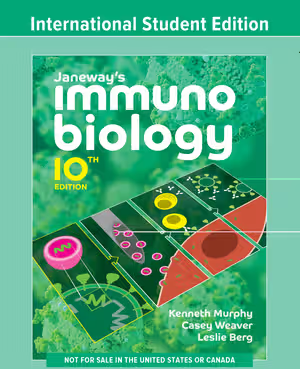
Murphy, K. M., Weaver, C., & Berg, L. J. (2022). Janeway's Immunobiology (10th ed.). W. W. Norton & Company.
Chapter Summary
The book has sixteen chapters in five parts, plus an appendix, and about 960 pages. The publisher describes it as a text for advanced undergraduate, graduate and medical school levels, with each chapter reviewed by experts. The tenth edition adds Leslie Berg as an author, material on SARS-CoV-2 and on the cGAS/STING pathway, and 88 new figures.
Part I, An Introduction to Immunobiology and Innate Immunity (Chapters 1–3): Basic Concepts in Immunology; Innate Immunity: The First Lines of Defense; Cellular Mechanisms of Innate Immunity
The first part introduces the basic vocabulary and architecture of the immune system and then treats innate immunity in two chapters: first the early lines of defence, then the cellular mechanisms behind them.
Part II, The Recognition of Antigen (Chapters 4–6): Antigen Recognition by B-cell and T-cell Receptors; The Generation of Lymphocyte Antigen Receptors; Antigen Presentation to T Lymphocytes
Antigen recognition is separated into how B-cell and T-cell receptors recognize antigen, how the diversity of these receptors is generated, and how antigens are presented to T lymphocytes.
Part III, The Development of Mature Lymphocyte Receptor Repertoires (Chapters 7–8): Lymphocyte Receptor Signaling; The Development of B and T Lymphocytes
Two chapters on what lymphocytes do after receptor engagement, namely receptor signalling, and on how B and T lymphocytes develop into mature repertoires.
Part IV, The Adaptive Immune Response (Chapters 9–12): T Cell–Mediated Immunity; The Humoral Immune Response; Integrated Dynamics of Innate and Adaptive Immunity; The Barrier Immune System
The effector side of adaptive immunity: T cell-mediated responses, the humoral (antibody) response, an integrating chapter on how innate and adaptive immunity operate together over time, and a chapter on the barrier immune system.
Part V, The Immune System in Health and Disease (Chapters 13–16): Failures of Host Defense Mechanisms; Allergic Diseases and Hypersensitivity Reactions; Autoimmunity and Transplantation; Manipulation of the Immune Response
The clinical part treats immune failure, allergy and hypersensitivity, autoimmunity and transplantation, and the deliberate manipulation of immune responses.
Appendix I: The Immunologist's Toolbox
A single appendix collects the experimental methods of immunology.
Key Concepts
Part I: innate immunity (Chapters 1–3)
- Innate immunity: the first lines of defence and their cellular mechanisms.
- Basic concepts: the framework chapter that introduces the rest of the book.
Parts II and III: recognition and development (Chapters 4–8)
- Antigen receptors of B and T cells: how they recognize antigen and how their diversity is generated.
- Antigen presentation: the delivery of antigen to T lymphocytes.
- Lymphocyte receptor signaling and development: the route from receptor engagement to mature B and T cell repertoires.
Parts IV and V: response and disease (Chapters 9–16)
- T cell-mediated and humoral immunity: the two effector arms of adaptive responses.
- The barrier immune system: treated in its own chapter.
- Hypersensitivity, autoimmunity and transplantation: disorders of immune function.
- Manipulation of the immune response: the closing chapter of the main text.
Critical Analysis
Strengths
- Comprehensive scope in a logical sequence. The five parts move from innate immunity through antigen recognition and lymphocyte development to adaptive responses and then to disease, so each chapter has the one before it as background.
- Integration across arms of the immune system. Chapter 11 is devoted to the dynamics of innate and adaptive immunity together, and Chapter 12 to the barrier immune system, rather than leaving mucosal and barrier tissues to a side topic.
- Currency and review. The publisher states that every chapter is reviewed by experts and that the tenth edition includes new work on SARS-CoV-2 and cGAS/STING and 88 new figures; the new author was added for this edition.
- Support for study. The publisher points to end-of-chapter thought questions, references and a toolbox appendix, along with the InQuizitive adaptive tool for vocabulary and concepts.
Limitations
- Size and level. At about 960 pages and aimed at advanced undergraduate, graduate and medical readers, it is much more than a first course needs; beginners should expect to select.
- Prerequisites. The site lists cell and molecular biology with some biochemistry, and a prior course in genetics or microbiology helps; Chapters 4–5 on receptors and their generation presuppose that background.
- Methods are separated. Experimental methods are collected in a single appendix rather than set within the chapters, so a reader interested in how findings were obtained must go there.
- Disease coverage is clinical-immunology level. Part V has four chapters; courses centred on infectious disease or clinical medicine will want additional sources.
Where It Fits in the Course
Janeway's Immunobiology is the reference-scale text in the immunology list. Immunology: A Short Course and The Immune System: A Very Short Introduction are brief first reads; the second is a short introduction by a clinical immunologist. Parham's The Immune System is a concise human-focused text that follows an infection from innate defences to adaptive immunity and then applies this to vaccination, allergy, autoimmunity, transplantation and cancer, so it is a natural step between a short course and Janeway. Kuby Immunology covers a similar range as Janeway and presents the field through the experiments that built it, with data-based problems; it is the closest alternative, and the choice between them is partly a matter of preferred style.
A typical sequence is a short course first, then Parham or Kuby for a full one-semester course, and Janeway as the detailed reference or for an upper-level course.
How to Use This Book
It suits advanced undergraduates, graduate students and medical students with cell and molecular biology behind them.
- Core: Chapters 1–3 for the framework and innate immunity, then Chapters 4–6 on recognition and Chapters 9–10 on the T cell and antibody responses. These make a self-contained route through the adaptive response.
- Second pass: Chapters 7–8 on signalling and development are the most mechanistic and reward a second reading after the effector chapters. Chapter 11 is useful as a synthesis once the pieces are known.
- By interest: Part V can be read selectively according to the course: Chapters 13–15 for disease, Chapter 16 for immunotherapy-style topics.
- Study habits: use the end-of-chapter thought questions, consult the Appendix when a method is unfamiliar, and keep a running list of cell types and receptors, since the vocabulary is large.