01 / Reading Guide
Reading Guide
Citation
Allison, L. A. (2021). Fundamental Molecular Biology (3rd ed.). Wiley-Blackwell.
Chapter Summary
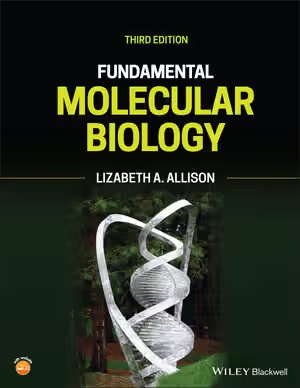
The third edition runs to about 816 pages in fifteen chapters, followed by an appendix, a glossary of about fifty pages and an index, with a companion website. The publisher describes it as a "selective and precise treatment" of essential topics for introductory molecular biology courses, organized around the process of discovery (observations, questions, experimental designs, results and conclusions) and the language of molecular biology. Each chapter opens with an outline; most close with a chapter summary, analytical questions, discovery questions and "real data" questions, followed by a bibliography. Three kinds of boxes run through the text: Focus boxes on experimental strategies and wider issues, Tool boxes on laboratory methods, and Disease boxes that place molecular mechanisms in a clinical context.
Chapter 1: The Beginnings of Molecular Biology
A historical opening. After defining the field, it traces the evidence for DNA as the hereditary material: Mendel's laws, the chromosome theory, the transforming principle, Hershey and Chase, and the one gene–one enzyme hypothesis. It continues to the double helix (with Rosalind Franklin's X-ray photographs) and the central dogma, and closes with an evolutionary framework for heredity that distinguishes positive selection from purifying selection and neutral fixation.
Chapters 2–4: The Structure of DNA; The Versatility of RNA; Protein Structure and Folding
The molecules themselves. Chapter 2 moves from the primary to the tertiary structure of DNA, including unusual secondary structures, with boxes on DNA origami and on triple-helix DNA in Friedreich's ataxia. Chapter 3 shows RNA's range of functions, its structural motifs, the discovery of RNA catalysis, the RNA world and RNA-based genomes (with a Disease box on emerging viral pathogens). Chapter 4 covers amino acids and the genetic code, three-dimensional structure, regulation of protein activity, and folding and misfolding, with prions as the disease example.
Chapter 5: Genome Organization and Evolution
How genomes vary between organisms, how eukaryotic DNA is packaged into chromatin, the large noncoding fraction of eukaryotic genomes, lateral gene transfer, and prokaryotic and viral genome organization, with mitochondrial DNA disease as a case.
Chapters 6–7: DNA Replication and Telomere Maintenance; DNA Repair Pathways
Chapter 6 runs from early insights into bacterial replication through DNA polymerases and the bacterial and eukaryotic replisomes to alternative modes of circular replication and telomerase. Its Disease boxes cover anticancer drugs that target topoisomerases and dyskeratosis congenita. Chapter 7 classifies mutations and DNA damage, then covers lesion bypass, direct reversal, repair of single-base changes and structural distortions, and double-strand break repair. Hereditary colorectal and breast cancer syndromes and xeroderma pigmentosum are the disease examples.
Chapters 8–9: Transcription in Bacteria; Transcription in Eukaryotes
Chapter 8 covers the mechanism of bacterial transcription, the lac operon as the classic model of gene regulation, the action of transcriptional regulators, regulation by RNA, and gene regulatory networks. Chapter 9 is one of the longest in the book. It covers eukaryotic regulatory elements, the general transcription machinery, specific transcription factors, coactivators and corepressors (with a Focus box asking whether there is a histone code), models of transcription-complex assembly, and the regulated nuclear import and export of transcription factors.
Chapter 10: Epigenetic Mechanisms
Epigenetic marks (DNA methylation, CpG islands, histone modifications), genomic imprinting, X-chromosome inactivation, the epigenetic control of transposable elements (beginning with Barbara McClintock's maize work), epigenetics and nutritional legacy, including whether transgenerational inheritance occurs in humans, and allelic exclusion. Disease boxes cover cancer, fragile X syndrome, imprinting disorders and trypanosomiasis.
Chapters 11–12: RNA Processing and Posttranscriptional Gene Regulation; The Mechanism of Translation
Chapter 11 runs from the discovery of split genes through the mechanisms of splicing, capping and polyadenylation, alternative splicing and RNA editing to RNA interference and microRNAs and RNA turnover. Chapter 12 covers ribosome structure and assembly, aminoacyl-tRNA synthetases, initiation, elongation (including the evidence that ribosomal RNA is the catalyst), termination and translational control.
Chapters 13–14: Recombinant DNA Technology and Genetically Modified Organisms; Tools for Analyzing Gene Organization, Expression, and Function
The two methods chapters. Chapter 13 runs from the origins of recombinant DNA through cloning, libraries, restriction mapping and DNA sequencing (Sanger to next-generation) to transgenic and knockout mice, CRISPR–Cas gene editing, gene drives and cloning by nuclear transfer. Chapter 14 covers DNA typing, genomics and proteomics, whole-genome sequencing, reporter genes, transcriptomics, proteomics, assays for nucleic acid–protein and protein–protein interactions, and structural methods including cryo-electron microscopy. Most of the book's Tool boxes are in these two chapters.
Chapter 15: Medical Molecular Biology
The book closes with applications to medicine: genomic medicine (genome-wide association studies, SNPs and structural variants, gene variants and behaviour, the human microbiome), the molecular biology of cancer (oncogenes, tumour suppressors, noncoding RNAs, chromosomal rearrangements, viruses and chemical carcinogens), and gene therapy, including the first gene-therapy fatality and therapy for cystic fibrosis.
Key Concepts
Chapters 1–5: Molecules and genomes
- Central dogma: the flow of information from DNA to RNA to protein, with exceptions such as reverse transcription and noncoding RNAs.
- Levels of nucleic acid structure: primary, secondary and tertiary structure of DNA and the structural motifs of RNA.
- Ribozymes and the RNA world: RNA as a catalyst, and the hypothesis that early life relied on RNA.
- Protein folding and misfolding: how proteins reach their functional shape and the diseases that follow when they do not.
- Chromatin and genome organization: the packaging of eukaryotic DNA, and the evolution of genome content.
Chapters 6–7: Maintaining the genome
- Replisome: the multiprotein machine that copies DNA in bacteria and eukaryotes.
- Telomerase: the enzyme that maintains chromosome ends.
- DNA repair pathways: bypass, direct reversal, excision repair and double-strand break repair.
Chapters 8–12: Gene expression and its regulation
- Operon: a bacterial unit of coordinately regulated genes, exemplified by lac.
- Transcription factors, coactivators and corepressors: proteins that control eukaryotic transcription.
- Epigenetic regulation: heritable control of gene expression through DNA methylation and chromatin, including imprinting and X inactivation.
- Alternative splicing and RNA interference: post-transcriptional ways of controlling gene output.
- The ribosome as a ribozyme: peptide bond formation catalysed by ribosomal RNA.
Chapters 13–15: Tools and medicine
- Recombinant DNA and cloning: cutting, joining and propagating DNA molecules.
- CRISPR–Cas gene editing: a bacterial immune system adapted for targeted genome modification.
- "-omics" and systems biology: genome-, transcriptome- and proteome-wide analysis.
- Oncogenes and tumour suppressors: genes whose activation or inactivation drives cancer.
Critical Analysis
Strengths
- Built around discovery. The publisher stresses the process of discovery, and the contents bear this out. Sections repeatedly begin with the experiments that revealed a mechanism (the transforming principle, early insights into replication, split genes, the evidence that rRNA forms the ribosome's active site, McClintock's maize work). Most chapters end with "real data" questions that ask students to interpret results.
- Disease and methods made integral. Disease boxes appear in almost every chapter and tie mechanisms to conditions such as xeroderma pigmentosum, fragile X syndrome and spinal muscular atrophy. The Tool boxes and two full methods chapters (13–14) give a practical grounding in laboratory techniques up to CRISPR and cryo-EM.
- Prokaryotes and eukaryotes compared. The publisher highlights the comparison between prokaryotic and eukaryotic organisms, and the contents treat replication, transcription and genome organization for both.
- Up to date in its third edition. The 2021 edition includes CRISPR–Cas editing, gene drives, next-generation and in situ methods, BioID and cryo-EM.
Limitations
- Not compact. Although the publisher presents it as selective, the book runs to about 816 pages, and long chapters such as 9, 13 and 14 are dense. It is a full course text, not a short primer.
- Uneven end-of-chapter support. According to the table of contents, Chapters 7 and 15 list no chapter summary, and Chapters 13 and 14, the two methods chapters, have no discovery or real-data questions. The study apparatus is therefore not uniform.
- Assumes some biology. The opening chapter reviews classical genetics quickly, as historical background, before moving to molecular detail. Students without a first course in biology or genetics may find the pace steep.
Where It Fits in the Course
Allison's book is the main undergraduate textbook in this course for a first full course in molecular biology. Before it, Molecular Biology: A Very Short Introduction by Divan and Royds offers a brief, non-technical overview of the field's history and molecules. Alongside or after it, two textbooks give a second view of the same core: Molecular Biology of the Gene (Watson and colleagues) presents nucleic acids, genome maintenance and gene regulation with attention to experimental methods; Craig and colleagues' Molecular Biology: Principles of Genome Function is organized around the genome and also treats bacteria, archaea and eukaryotes side by side.
For advanced study, Lewin's Genes is a comprehensive treatment of gene structure, organization and expression, and Zlatanova's Molecular Biology: Structure and Dynamics of Genomes and Proteomes explains the same processes through molecular structure and single-molecule experiments.
How to Use This Book
The book is aimed at undergraduates in an introductory molecular biology course, taken after introductory biology and some chemistry. A prior genetics or cell biology course helps with the pace of the early chapters.
A suggested plan for one semester:
- Core: Chapters 1–4 (background and molecules), 6 (replication), 8–9 (transcription), 11–12 (RNA processing and translation). These cover the central dogma in depth.
- Second tier: Chapters 5, 7 and 10 (genome organization, repair, epigenetics). Include them if time allows; Chapter 10 is especially relevant to current research.
- Methods: use Chapters 13–14 as reference alongside lab work, reading the relevant Tool boxes when a technique first appears in an earlier chapter.
- Applications: Chapter 15 suits the final weeks or a project.
Work through the analytical questions at the end of each chapter, and give particular time to the real-data questions, which train you to read experiments rather than memorize conclusions. Use the Disease boxes as test cases: for each, explain the defect in terms of the mechanism the chapter has just described. Use the chapter bibliographies to find the original papers behind key experiments.