01 / Reading Guide
Reading Guide
Citation
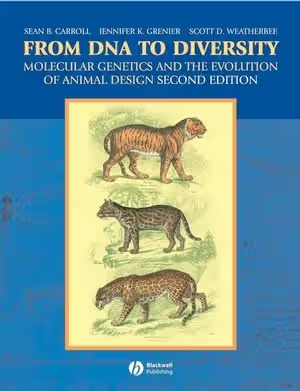
Carroll, S. B., Grenier, J. K., & Weatherbee, S. D. (2004). From DNA to Diversity: Molecular Genetics and the Evolution of Animal Design (2nd ed.). Blackwell Publishing.
Chapter Summary
The second edition is a short book of eight chapters, listed at 258 pages in the library record and 270 in the publisher's listing. The publisher describes it as a synthesis of evolutionary biology with genetics and embryology that presents the general principles of the genetic basis of morphological change, building from developmental genetics and regulatory mechanisms to evolution at different genetic and morphological levels, with in-depth case studies, chapter summaries, references and a glossary. The second edition adds coverage of comparative genomics, the molecular evolution of regulatory proteins and elements, and the microevolution of animal development, together with a new chapter on models of variation and divergence among closely related species. The review by Hammond and Whitfield in Heredity (2006) supplies much of the detail below about how the argument runs.
Chapter 1: A Brief History of Animals
The opening chapter surveys the origins of the diversity of animal form. Hammond and Whitfield find the account of the fossil evidence tantalisingly brief, concentrating on the origin and diversification of animal forms in the Cambrian, and note that they would have liked a similar introduction to later transitions, such as the evolution of jaws in vertebrates.
Chapter 2: The Genetic Toolkit for Development
The emphasis shifts to a developmental perspective with the basic genetic "toolkit" from which animals are built. The review says that the main focus here is the fruit fly, and that although developmental biologists could skip these chapters, they serve as a reminder of early Drosophila development.
Chapter 3: Building Animals
The third chapter of the opening block, on how animals are built. The review treats the toolkit and developmental chapters together as the basics: only after they are established does the book turn to the genetic changes behind morphological variation.
Chapters 4–6: Evolution of the Toolkit; Diversification of Body Plans and Body Parts; The Evolution of Morphological Novelties
The book then asks how the toolkit evolves and how its changes produce differences in body plans and body parts. The review mentions several examples from the later part of the book: the loss of limbs from the segmented arthropod body plan, the changes in Hox expression behind the diversification of insect wing appendages (from beetle elytra to the fly haltere), and a section on novelties, such as the turtle shell, and atavisms, a return to ancestral forms. The review also notes that the evolution of the Hox complex is treated in some detail.
Chapter 7: Morphological Variation and Species Divergence
The chapter that is new to the second edition, on models of variation and divergence among closely related species. The review reports that the book discusses natural variation within a species, with mammal coat colours as a simple, familiar example traced to variants in pigmentation-pathway genes.
Chapter 8: From DNA to Diversity: The Primacy of Regulatory Evolution
The final chapter states the book's thesis, which the review summarises as follows: changes in gene regulatory sequences, rather than in protein-coding regions, have driven changes in morphology. In its last pages it returns to the debate between Darwin and Bateson over gradual versus saltational change, concluding on the side of Darwin that small, gradual changes accumulated over millions of years can lead to speciation, with caveats and assumptions stated.
Key Concepts
Chapters 1–3
- Genetic toolkit for development: the set of genes shared by animals from which bodies are built, the subject of Chapter 2.
- Cambrian diversification: the origin of the major animal forms, Chapter 1.
Chapters 4–7
- Hox genes and body plans: the evolution of the Hox complex and its effect on body parts such as insect wings.
- Morphological novelties and atavisms: new structures and returns to ancestral forms, Chapter 6.
- Variation within and between species: Chapter 7.
Chapter 8
- Primacy of regulatory evolution: the view that changes in regulatory DNA, more than in coding sequences, underlie morphological change.
- Gradualism: small changes accumulating over long periods, as against sudden changes.
Critical Analysis
Strengths
- A focused, short text. The review describes the book as small enough to keep a coherent story throughout, and as a general introduction setting out key concepts and illustrating them with carefully chosen examples from across the animal kingdom, not a comprehensive text.
- Appropriate detail and good referencing. According to the review the level of detail is enough for understanding each topic without disrupting the general thread, and the reference lists are comprehensive enough to follow up examples.
- Illustration. The review praises the illustrations, which range from photographs of striking examples to diagrams and flow charts, and the publisher advertises four-colour illustrations.
- A clearly argued thesis. The review credits the authors with setting the regulatory-evolution idea in the context of the preceding chapters and with being clear and honest about the caveats and assumptions behind their conclusion.
Limitations
- Gaps noted by reviewers. Hammond and Whitfield find the fossil account brief, and say that an overview of genome structure and of the range of genetic differences between species would have been helpful. Large-scale chromosomal rearrangements, they note, are not covered anywhere in the book.
- Developmental background may be repeated. The review says developmental biologists could skip the toolkit chapters, which have a major focus on the fruit fly; students who already have a developmental biology course will find Chapters 2–3 familiar.
- Date of publication. The book appeared in 2004, and its comparative-genomics coverage reflects the genome studies available then; it is best read as an introduction to the ideas, with newer literature checked separately.
Where It Fits in the Course
The course covers developmental biology at several levels. Wolpert's Developmental Biology: A Very Short Introduction and Davies's Life Unfolding are accessible accounts of how an embryo forms, and Essential Developmental Biology (Slack and Dale) and Barresi and Gilbert's Developmental Biology are textbooks that work through the main model organisms and mechanisms. Wolpert's Principles of Development is an advanced introduction to pattern formation and signalling.
Carroll, Grenier and Weatherbee is the evolutionary counterpart to all of these. It asks not how an embryo develops but how developmental programmes change over evolutionary time. Read it after at least one of the developmental textbooks, or alongside Essential Developmental Biology for the model-organism background, and before turning to the research literature on evolutionary developmental biology.
How to Use This Book
The review describes the book as aimed primarily at undergraduates or non-specialists, though it will be enjoyed by specialists as well; the frontmatter lists developmental biology and molecular genetics with some introduction to evolution as prerequisites. A student who knows Hox genes and the Drosophila body plan can start at Chapter 4.
A practical plan:
- Core: Read the book in order; at eight short chapters it can be read in a few sittings. Chapters 2 and 3 can be skimmed by readers who know Drosophila development.
- Central chapters: Chapters 4–6 hold the main examples of how regulatory change produces new body plans and structures.
- Closing argument: Chapter 8 states the thesis; read it twice, once before the examples and once after.
- Follow-up: Use the reference lists to pick papers that match the examples that interest you, and use the glossary for terms.