01 / Reading Guide
Reading Guide
Citation
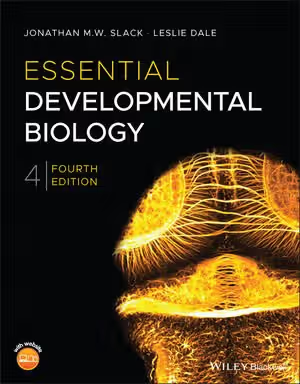
Slack, J. M. W., & Dale, L. (2021). Essential Developmental Biology (4th ed.). Wiley.
Chapter Summary
The fourth edition has 24 chapters in four sections and about 544 pages. According to the publisher, it is a short, focused core text for undergraduates and first-year graduate students that avoids discussion of history and experimental priority, and the new edition adds single-cell transcriptome sequencing, CRISPR/Cas9 and other targeted genetic methods and reorganises existing material for easier reading. The four sections are Groundwork (Chapters 1–6), Major model organisms (Chapters 7–14), Organogenesis (Chapters 15–19) and Growth, evolution, regeneration (Chapters 20–24).
Chapter 1: The excitement of developmental biology
A short opening chapter on where the subject came from (experimental embryology, developmental genetics and molecular biology), its practical impact (in vitro fertilization, teratology, birth-defect screening, growth factors, genetically modified mice and stem cells) and likely future impact, including ethical questions.
Chapter 2: How development works
An "ultrashort summary" of the whole process, followed by gametogenesis, early development, and growth and death.
Chapters 3–5: Approaches to development: developmental genetics; Approaches to development: experimental embryology and its molecular basis; Approaches to development: cell and molecular biology techniques
Three chapters introduce the methods of the field. The first covers mutants, genetic mosaics, screening, gene cloning, transgenesis, and gain- and loss-of-function techniques. The second treats normal development, developmental commitment, criteria for proof, transcription factors, signalling systems and genetic regulatory networks. The third covers microscopy, histology, microinjection, methods for studying gene expression, reporter genes and cell labelling.
Chapter 6: Cells into tissues
Cells in embryos: the cytoskeleton, small GTP-binding proteins, extracellular matrix, cell movement, epithelial organisation and morphogenetic processes.
Chapter 7: Major model organisms
A comparison of "the big six" in terms of access and micromanipulation, genetics and genomes, and relevance and tempo, with a short look at other organisms.
Chapters 8–11: Xenopus; The zebrafish; The chick; The mouse
Each vertebrate chapter covers normal development and a fate map, together with the methods and the regional specification particular to that animal. The mouse chapter also covers fertilization, transgenic mice, embryonic stem cells, knockouts and knock-ins, nuclear transplantation and imprinting, and X-inactivation.
Chapter 12: Human early development
Human reproduction, preimplantation and postimplantation development, human embryonic stem cells, prenatal diagnosis and the ethics of human development.
Chapters 13–14: Drosophila; Caenorhabditis elegans
The two invertebrate models: the fly's fate map, pole plasm and genetics, with the dorsoventral and anteroposterior patterning systems, and the worm's embryonic and postembryonic development, the germ line and programmed cell death.
Chapter 15: Techniques for studying organogenesis and postnatal development
Genetics, clonal analysis, tissue and organ culture, and cell analysis and separation.
Chapters 16–19: Development of the nervous system; Development of mesodermal organs; Development of endodermal organs; Drosophila imaginal discs
The nervous system chapter covers regional specification, neurogenesis, the neural crest and connectivity. The mesodermal chapter includes somitogenesis, limb development, blood vessels and the heart; the endodermal chapter treats the gut tube and pancreas; and the imaginal disc chapter covers metamorphosis, compartments and selector genes, and regeneration.
Chapters 20–22: Tissue organization and stem cells; Growth, aging, and cancer; Pluripotent stem cells and their applications
Tissue renewal in the intestine, epidermis, hair follicle and blood; growth control, aging and cancer; and human embryonic and induced pluripotent stem cells with their therapeutic uses.
Chapters 23–24: Evolution and development; Regeneration of missing parts
Evolutionary themes (Hox genes, vertebrate limbs) and the types, mechanisms and properties of regeneration.
Key Concepts
Chapters 1–6: Groundwork
- Developmental commitment: the stage at which cells become restricted to a fate.
- Genetic regulatory network: the interacting transcription factors and signals that organise gene activity.
- Genetic mosaic and transgenesis: methods for testing gene function in the embryo.
- Morphogenetic processes: the cell behaviours that shape tissues.
Chapters 7–14: Model Organisms
- Fate map: a chart of what each region of the early embryo will become.
- Pole plasm and the dorsoventral and anteroposterior systems: the Drosophila chapters' route to body-plan patterning.
- Knockouts and knock-ins: mouse genetic techniques.
Chapters 15–24: Organs, Stem Cells and Regeneration
- Somitogenesis: formation of the segmented mesoderm.
- Induced pluripotent stem cells: pluripotent cells derived from adult cells.
- Imaginal discs and selector genes: the Drosophila larval structures that give rise to adult parts.
- Regeneration: restoration of missing parts, examined in planarians, insects and vertebrate limbs.
Critical Analysis
Strengths
- Compactness. The publisher stresses that the authors have kept the text short and focused on what is central, and the 24 chapters fit in about 544 pages.
- Methods before organisms. Section 1 devotes three chapters to approaches (developmental genetics, experimental embryology and its molecular basis, and cell and molecular techniques) before any organism is studied, so the later chapters can refer back to them.
- Even treatment of model systems. Chapter 7 compares the organisms, and Chapters 8–14 treat each one in turn. Human development has its own chapter, including ethical questions.
- Applications and closing themes. The last section covers tissue renewal, growth and cancer, pluripotent stem cells and their therapeutic uses, evolution and regeneration.
Limitations
- Animal-only scope. The publisher describes the fundamentals of animal development, and the contents list no chapter on plants.
- Limited historical narrative. The publisher says the book avoids history and experimental priority, and Chapter 1 gives only a short outline of the subject's origins. Readers wanting the classic experiments told as a story need another text.
- A concise treatment. At about 544 pages the book gives each topic less room than the comprehensive texts, and the Chapter 1 reading list sends readers to other books for fuller descriptive and analytical accounts.
Where It Fits in the Course
Slack and Dale is the compact core text among the developmental biology books on this site. Michael Barresi and Scott Gilbert's Developmental Biology is the comprehensive alternative, with 26 chapters, companion videos and tutorials, and about 840 pages; the reading list in Slack and Dale's Chapter 1 cites an earlier edition (the twelfth) among its "mainly analytical" textbooks, alongside Wolpert's Principles of Development. Choose Slack and Dale for a one-semester course or a first pass, and Barresi and Gilbert for a course that wants more detail and a wider range of organisms.
Wolpert's Principles of Development is an advanced introduction to pattern formation, signalling and gene regulation. At the other end, Lewis Wolpert's Developmental Biology: A Very Short Introduction and Jamie Davies's Life Unfolding are short, accessible books for readers who are not specialising. Sean Carroll and colleagues' From DNA to Diversity follows up the evolution chapter (Chapter 23) in depth.
How to Use This Book
The book is aimed at first- to fourth-year undergraduates and first-year graduate students, in both biological and medically oriented courses. It presumes no prior knowledge of development, animal structure or histology, but introductory biology and basic cell and molecular biology are assumed.
A practical plan for a one-semester course:
- Core: Chapters 1–2 for the overview, then Chapters 3–6. Students with a strong genetics background can skim Chapter 3.
- Model organisms: read Chapter 7 and then choose the organisms that match the course. Chapters 11 (mouse) and 13 (Drosophila) carry the most genetic technique, from knockouts and knock-ins to the patterning systems of the fly; Chapter 12 connects to human biology.
- Organs: Chapters 16–18 for the nervous system and the mesodermal and endodermal organs; Chapter 19 is optional and applies Drosophila concepts.
- Closing section: Chapters 20–24 for stem cells, growth, evolution and regeneration, which suit courses with a medical or applied emphasis.
A companion website accompanies the book, and the reading list at the end of Chapter 1 is a useful route to descriptive texts, analytical texts and review articles.