01 / Reading Guide
Reading Guide
Citation
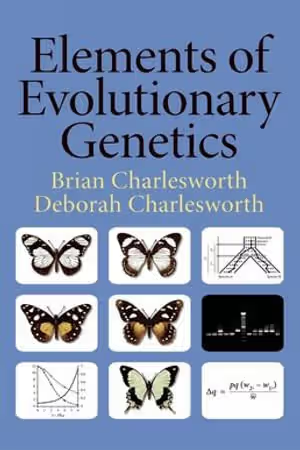
Charlesworth, B., & Charlesworth, D. (2010). Elements of Evolutionary Genetics. Roberts and Company Publishers.
Chapter Summary
The book has ten chapters and a mathematical and statistical appendix, and runs to about 768 pages according to the review in Nature Genetics (Mackay, 2010). The publisher's description says it teaches how models of the genetic processes involved in evolution are made and how they are used to interpret classical and molecular genetic data. Mackay's opening paragraph defines the field in the same terms: how mutation and recombination, acted on by selection, genetic drift and migration, produce patterns of genetic variation at segregating loci and for quantitative traits, within and between populations and over short and long timescales; and how that theory is then applied to observed allele-frequency distributions and the genetic variance of quantitative traits, in order to infer which regions of the genome evolve as expected under a balance between neutral mutation and drift and which show signatures of departure, for example from balancing selection, selective sweeps or the removal of deleterious mutations. The chapter sequence below fits that picture.
Chapter 1: Variability and Its Measurement
The opening chapter deals with genetic variation and how it is measured.
Chapter 2: Basic Selection Theory and the Maintenance of Variation
Selection acting on a single locus and the conditions under which variation is maintained rather than lost.
Chapter 3: Directional Selection and Adaptation
Directional selection, the process most closely tied to adaptation, treated at the genetic level.
Chapter 4: Migration, Mutation and Selection
Migration, mutation and selection, taken together as processes that change genetic variation.
Chapter 5: The Evolutionary Effects of Finite Population Size: Basic Theory
The basic theory of what happens genetically when populations are of finite size, which is where genetic drift enters the book.
Chapter 6: Molecular Evolution and Variation
The connection to DNA sequence data: how variation and divergence observed at the molecular level are interpreted with the models developed earlier.
Chapter 7: Genetic Effects of Spatial Structure
The genetic consequences of spatial structure in populations.
Chapter 8: Multiple Sites and Loci
The treatment extended from a single locus to multiple sites and loci.
Chapter 9: The Evolution of Breeding Systems, Sex Ratios and Life Histories
An application chapter that uses the genetic models to address the evolution of mating systems, sex ratios and life histories.
Chapter 10: Some Topics in Genome Evolution
The closing chapter turns to selected topics at the level of whole genomes.
Mathematical and Statistical Appendix
A reference section on the mathematics and statistics the chapters use.
Key Concepts
Chapters 1–4
- Genetic variability and its measurement: Chapter 1.
- Selection and the maintenance of variation: Chapter 2.
- Directional selection and adaptation: Chapter 3.
- Migration, mutation and selection: the combined action of forces, Chapter 4.
Chapters 5–8
- Finite population size and drift: Chapter 5.
- Molecular evolution and variation: Chapter 6.
- Spatial structure: Chapter 7.
- Multiple sites and loci: Chapter 8.
Chapters 9–10 and appendix
- Breeding systems, sex ratios and life histories: Chapter 9.
- Genome evolution: Chapter 10.
Critical Analysis
Strengths
- Builds from first principles to data. The chapter order starts with variation and its measurement, develops selection, drift and migration, and only then applies the theory to molecular data, space, multiple loci, breeding systems and genomes. The publisher presents the book as a guide to how the models are made as well as how they are used.
- Explicit link to modern data. Mackay's review describes the application of the theory to allele-frequency distributions and quantitative-trait variance, and the contents list gives molecular evolution and genome evolution their own chapters.
- Authors who work in the field. The publisher's note says both authors are Fellows of the Royal Society and work on population genetics, molecular and genome evolution, and mating-system evolution; they are also the authors of Evolution: A Very Short Introduction.
- A dedicated mathematical appendix. The separate appendix on mathematical and statistical methods keeps derivations available without placing every technique in the chapters.
Limitations
- Demanding. The book is about 768 pages of theory. The frontmatter lists courses in genetics and evolution plus comfort with algebra, calculus and basic probability; readers lacking these will find it hard going.
- Narrow in subject. The contents are about genetic processes and their models. Phylogenetics, the fossil record, speciation and the evolution of behaviour are not in the chapter titles, so the book complements a general evolution text rather than replacing one.
- Public evidence is thin. The contents list and publisher description do not show whether there are exercises or how the chapters are paced, so those questions cannot be settled from these sources.
Where It Fits in the Course
The other evolution books in this course are broader. Zimmer's The Tangled Bank and the Charlesworths' own Evolution: A Very Short Introduction are first encounters, the second written by the same authors as a concise account of how common ancestry, natural selection and other processes explain adaptation, new species and the history of life. Bergstrom and Dugatkin's Evolution and Futuyma and Kirkpatrick's Evolution are undergraduate textbooks that cover the whole subject, and Darwin's On the Origin of Species is the foundational work.
Elements of Evolutionary Genetics is the specialised, mathematical companion to these. It makes sense after a general evolution course, and especially after the population-genetics chapters of Futuyma and Kirkpatrick, when the reader wants to see the models derived and tested against data.
How to Use This Book
The book is for graduate students and advanced undergraduates in evolution, genetics or related fields who have taken genetics and evolution and are comfortable with algebra, calculus and basic probability.
A practical plan:
- Core: Chapters 1–5 in order. They establish variation, selection, mutation, migration and drift, on which the rest depends.
- Next: Chapter 6 for molecular data and Chapter 8 for multi-locus models, read with the appendix open.
- By interest: Chapter 7 for spatial structure, Chapter 9 for breeding systems, sex ratios and life histories, and Chapter 10 for genome evolution.
- Practice: Work through the derivations yourself, with a general evolution text open for the biological context.