01 / Reading Guide
Reading Guide
Citation
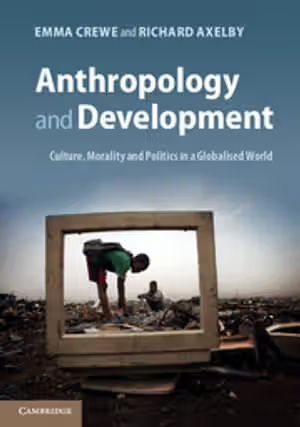
Crewe, E., & Axelby, R. (2012). Anthropology and Development: Culture, Morality and Politics in a Globalised World. Cambridge University Press.
Chapter Summary
Context and Argument
Emma Crewe and Richard Axelby, both at SOAS, University of London, and both with experience of working in development (Crewe in South Asia, East Africa and the UK; Axelby with development and education NGOs in South Asia and the UK), wrote this textbook to show what anthropology reveals about aid and development. The book treats development as "Development World", a world-shaping industry of donors, states, NGOs, companies, professionals and the people they aim to help, and argues that people experience development not in the idealised categories of plans and policies but in the "spaces between": between policy and practice, success and failure, past and future. The authors distance themselves both from polarised pessimism and from exaggerated promises. Each chapter opens with key points and ends with "challenging questions"; boxes present case material, ethical codes and interviews, and an appendix collects questions arising from the whole book. The paperback has about 270 pages in nine chapters.
Chapter 1: Introduction: Hope and Despair
The introduction describes the "emotional geography" of development and reviews successive ways of seeing it: development as easy, as modernity, as control and as discourse, the last including post-development critics such as Arturo Escobar and Wolfgang Sachs. It then sets out the relationship between anthropology and development and the themes and structure of the book.
Chapter 2: Anthropologists Engaged
A history of anthropology's involvement in practical affairs, from its early beginnings under colonialism through the move "from academic purity to dirty engagement", problems of compromise and complicity (including anthropologists embedded with the military), and the crisis of modernity and the postmodern turn, to a way "beyond the impasse": anthropology both in and of development. Boxes discuss ethical codes, an interview with David Mosse about writing his ethnography of a development project, and a case of how anthropology helped explain the adoption of cooking stoves.
Chapter 3: The Social and Political Organisation of Aid and Development
This chapter maps the shape of Development World and the relationships within it: donors and recipients, states, Northern and Southern NGOs and civil society, corporate social responsibility, and the judgements different actors make about each other, with ethnographic examples ranging from a poverty programme in Indonesia to mining and corporate philanthropy.
Chapter 4: The Elusive Poor
Poverty reduction is examined as a "taken-for-granted" goal of development. The chapter considers poverty reduction strategies, livelihoods frameworks, entitlement and capability approaches associated with Amartya Sen, class and power, wellbeing, money, culture and happiness, and how classifications of the poor shape official responses, including debates about identity and gender in politics.
Chapter 5: Human Rights and Cultural Fantasies
The authors examine the universality of human rights as an organising principle for development, then rights and childhood, rights and community, and the complexity of applying rights in practice. They argue that focusing on the needs of "the child" can encourage individualised assessments at the expense of social analysis.
Chapter 6: Hierarchies of Knowledge
This chapter looks at how technologies and knowledge are produced, used and valued: science and the promise of modernity, debates over biotechnology, alternative approaches to technology, local knowledge (including in natural disasters), and the relationship between knowledge and power. It argues that hierarchies of knowledge mirror relations of power between aid agencies and the people they work with.
Chapter 7: The Moralities of Production and Exchange
Economic life is treated as moral and cultural as well as material, with ethnographic examples that include financial markets and their elites and a women's labour organisation in India (SEWA).
Chapter 8: The Politics of Policy and Practice
Drawing on ethnographies such as Mosse's Cultivating Development, the chapter argues that policy legitimises practice rather than driving it, and that success and failure are socially produced. It examines planning ("imagining the future: the plan"), audit cultures and evaluation, and forced displacement.
Chapter 9: Imagining the Future
The conclusion develops the idea of the "spaces between", the role of ritual and symbolism in development encounters, and the future relationship between anthropology and development; the authors see probing the policies and practices of Development World with difficult questions as one of anthropology's most useful tasks.
Key Concepts
Chapters 1–3: Development and Its Worlds
- Development World and Aidland: the global industry of agencies and professionals pursuing planned change, and the increasingly dominant world of aid transfers within it.
- Development as discourse: the post-development argument that development is a system of representations that constructs the problems it claims to solve.
- Anthropology in and of development: the difference between applying anthropology within development work and studying development itself as an object.
Chapters 4–6: Poverty, Rights and Knowledge
- Capabilities and entitlements: approaches to poverty that look beyond income to what people are able to do and claim.
- Universal rights and cultural difference: the tension between universal human rights frameworks and local understandings of childhood and community.
- Hierarchies of knowledge: the ranking of scientific and expert knowledge above local knowledge, reflecting power relations.
Chapters 7–9: Economy, Policy and the Future
- Moral economy of exchange: the view that production and exchange are embedded in moral and cultural relations.
- Policy and practice: the argument that policy legitimises rather than drives practice, and that success is socially produced.
- Audit culture: accountability through targets and indicators that may block participation and learning.
- The spaces between: the gaps between categories where, the authors argue, development is actually experienced.
Critical Analysis
Strengths
- Written from inside and outside development. Both authors have worked as practitioners as well as academics, and the book addresses practitioners directly: the introduction warns that anthropological insight will not make development easier, but may make its frameworks and tools usefully unstable.
- Broad, ethnographically grounded coverage. Nine chapters move from the history of engagement to aid organisations, poverty, rights, technology, economy and policy, drawing on a large literature of ethnographic case studies (Mosse, Li, Scott and many others).
- Designed for teaching. Key points at the start and challenging questions at the end of every chapter, boxed cases and interviews, and a book-wide appendix of questions make it easy to use in seminars.
- Balanced tone. The authors set out to avoid both the despair of discourse critiques and the optimism of policy rhetoric, presenting development as a field of negotiation over power and culture.
Limitations
- Published in 2012. Policy debates centre on the Millennium Development Goals, structural adjustment and the aid architecture of the 2000s; the Sustainable Development Goals, the growth of new donors and recent debates on decolonising aid are not covered.
- Thematic rather than historical or theoretical depth. Development theories are introduced compactly in the first chapter; students who need a fuller account of theories should turn to a dedicated text.
Where It Fits in the Course
Within the course on globalisation and development this is a first textbook on the anthropology of development, written for students new to both fields. Thomas Hylland Eriksen's Globalization: The Key Concepts is the companion introduction to globalisation itself; reading both gives the broader global processes and the specific world of aid. Katy Gardner and David Lewis's Anthropology and Development: Challenges for the Twenty-First Century covers similar ground with an argument about the technocratic turn of the development industry; it works well after Crewe and Axelby, who cite the authors' earlier work as an example of anthropology designed to improve development practice.
Arturo Escobar's Encountering Development, a key source for the discourse critique summarised in Chapter 1, should be read after this book by students who want the post-development argument in full. Talal Asad's edited volume Anthropology and the Colonial Encounter extends the history of anthropology and colonialism outlined at the start of Chapter 2.
How to Use This Book
The book assumes no previous study of anthropology or development studies and suits undergraduates in anthropology, development studies, international relations or related fields, as well as practitioners who want an anthropological perspective on their work.
- Read Chapters 1–3 first. They provide the framework: ways of seeing development, the history of anthropological engagement, and the organisation of Development World.
- Then choose by theme. Chapters 4–8 can be read in any order according to the course: poverty, rights, technology and knowledge, economy, policy and practice.
- Finish with Chapter 9, which draws the themes together.
Use the challenging questions at the end of each chapter for seminar preparation, and follow up the boxed case studies and cited ethnographies, such as Mosse's Cultivating Development, when writing essays. For current debates, pair chapters with recent articles on the Sustainable Development Goals and decolonising aid.