01 / Reading Guide
Reading Guide
Citation
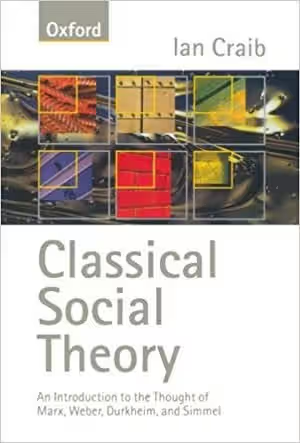
Craib, I. (1997). Classical Social Theory: An Introduction to the Thought of Marx, Weber, Durkheim, and Simmel. Oxford University Press.
Chapter Summary
The book is about 300 pages of text, followed by a "Dramatis Personae" of thirty-one other thinkers (an alphabetical list running from Adorno and Althusser to Wittfogel), a glossary, references and an index. Its publisher describes a thematic structure that lets readers compare the four theorists systematically, together with a book-by-book attention to each thinker's key texts, quoting and analysing the most important passages. The contents list below follows the publisher's table of contents; it gives titles and page positions, not chapter numbers, and the front matter lists chapter summaries and boxes.
What's the Point? and The Main Characters and the Main Ideas (pp. 1–62)
The opening sections explain why classical theory is worth studying and introduce the four thinkers and their central ideas before the detailed treatment begins. They are followed by four short portraits that the contents list titles "Durkheim: the discovery of social facts", "Karl Marx: the primacy of production", "Max Weber: the primacy of social action" and "Georg Simmel: society as form and process - the outsider's view". Each portrait is about ten pages and frames its thinker through a single organising idea.
Round one: Durkheim, Marx, Weber, Simmel (pp. 63–186)
The first extended treatment takes the four thinkers in turn: "Durkheim: drunk and orderly" (p. 63), "Was Marx a Marxist?" (p. 86), "The liberal Weber" (p. 119) and "Simmel: the social and the personal" (p. 146). The titles show that each thinker is approached through a particular angle, including a question about Marx's relation to Marxism and a description of Weber as a liberal. The reviewer Felice Dassetto describes the book's three recurring topics as the view of society and the paradigm for studying it, the analysis of social structure, and history and social change.
Round two: Durkheim, Marx, Weber, Simmel (pp. 187–264)
The same order repeats with a different focus: "Durkheim's organic analogy" (p. 187), "Marx and the meaning of history" (p. 204), "Weber as a tragic liberal: the rise of the West" (p. 232) and "Simmel: countering an overdose of history?" (p. 261). The titles of this round refer to history, meaning and the rise of the West, so it is the part of the book where each thinker's account of historical change is laid out.
Conclusion: The Framework of Social Theory (p. 265)
A closing section of a few pages draws the comparison together under the heading of a framework for social theory, before the Dramatis Personae, glossary and references.
Key Concepts
Introductory portraits (pp. 25–62)
- Social facts: Durkheim's term, named in the contents list as his discovery, for features of social life that can be studied as things in their own right.
- Primacy of production: the idea attached to Marx's title that social life is to be understood first through how people produce.
- Primacy of social action: the corresponding organising idea for Weber, who begins from what individuals meaningfully do.
- Society as form and process: the idea in Simmel's portrait, which adds "the outsider's view", the standpoint of someone at the edge of a group.
The comparative rounds (pp. 63–264)
- Organic analogy: the comparison of society with a living organism, which Craib discusses in connection with Durkheim.
- Meaning of history: the question of whether and how Marx finds a direction in historical development.
- Tragic liberal: the description applied to Weber, linked in the contents to the "rise of the West".
Critical Analysis
Strengths
- Systematic comparison. Because the four thinkers are taken in parallel rounds, with the same themes returning, the reader can compare them point by point. Dassetto praised this parallel treatment, and the chapter summaries and diagrams that help readers follow the line of argument.
- Attention to texts. The publisher states that the book works through each thinker's key texts and quotes the most important passages, so readers meet the arguments in the thinkers' own words rather than only in paraphrase.
- Student-friendly reference matter. The Dramatis Personae and glossary give short accounts of other thinkers and terms, so a reader meeting Hegel, Comte or Spencer for the first time has a place to look. Dassetto also notes a useful analytical index of concepts.
- Accessible reception. Published reviews stress clarity: Talja Blokland (The European Legacy 5(2), 2000) wrote that the book brings the thinkers' thoughts alive and shows why they matter, and a teacher quoted by the publisher, Malcolm Williams, called it a good core text for students who fear theory.
Limitations
- Four thinkers only. The scope is fixed by the subtitle. Spencer, Mead and others are listed in the Dramatis Personae rather than treated at length, and writers such as Martineau, Du Bois or Gilman do not appear even in the Dramatis Personae.
- Thinkers are split across the book. The thematic design means that a reader who wants one thinker's whole argument must move between sections many pages apart.
- Dating. The book is from 1997 and the sources consulted list no later edition, so it does not reflect more recent scholarship on the classical canon.
Where It Fits in the Course
Within the classical theory list, Craib is a compact first guide to four thinkers, to be read before or alongside primary texts. Allan and Daynes's Explorations in Classical Sociological Theory covers a wider range, adding figures such as Spencer, Mead, Martineau and Du Bois, in a more conversational and pedagogical textbook format. Giddens's Capitalism and Modern Social Theory also compares Marx, Durkheim and Weber but is a comparative analysis that challenges received readings of the three, and so suits a reader who already has a first overview such as this one.
The primary-source books on the list, Durkheim's The Division of Labor in Society and Weber's The Protestant Ethic, are what Craib's book prepares for, and the edited reader Classical Sociological Theory supplies the original selections that his text discusses. Nisbet's The Sociological Tradition, organised around the ideas of community, authority, status, the sacred and alienation, offers a different, idea-centred route into the same period.
How to Use This Book
The book is aimed at readers new to classical theory; the site lists no prerequisite, and the publisher's own description calls it a guide for anyone new to the subject. Reviewers quoted by the publisher regard it as suitable for undergraduates and for graduate students with no prior training in classical theory.
A practical plan: start with the introductory sections and the four short portraits (pp. 1–62) to get the vocabulary. Then, rather than reading round by round, you can follow one thinker at a time through his two sections, for example Marx on pp. 86 and 204, and finish with the conclusion on p. 265. Use the Dramatis Personae and glossary whenever a name or term is unfamiliar, and read the chapter summaries before and after each section. Alongside the book, read a short primary text for each thinker, such as the Durkheim or Weber titles in the course list, so that Craib's quotations can be checked against whole arguments.