01 / Reading Guide
Reading Guide
Citation
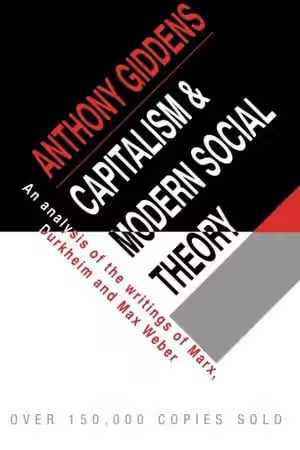
Giddens, A. (1971). Capitalism and Modern Social Theory: An Analysis of the Writings of Marx, Durkheim and Max Weber. Cambridge University Press.
Chapter Summary
The book is about 280 pages in four parts with fifteen numbered chapters and a short postscript. The first three parts give each of the three authors a separate treatment based on close examination of the original texts, and the fourth part compares them. The publisher describes the aim of the first three parts as showing the internal coherence of each writer's contribution to social theory, and of the last as discussing the main ways in which Marx can be compared with the other two and some misconceptions of conventional views.
Part 1, Chapters 1–4: Marx
The four chapters on Marx are "Marx's early writings", "Historical materialism", "The relations of production and class structure" and "The theory of capitalist development". The titles suggest a progression from the early writings through the general theory of history to the analysis of classes and of capitalism. Together the four chapters run to about sixty pages.
Part 2, Chapters 5–8: Durkheim
The Durkheim chapters are "Durkheim's early works", "Durkheim's conception of sociological method", "Individualism, socialism and the 'occupational groups'" and "Religion and moral discipline". They move from the early writings to the method of sociology, then to Durkheim's views on individualism, socialism and occupational groups, and finally to religion and moral discipline.
Part 3, Chapters 9–12: Max Weber
The Weber chapters are "Max Weber: Protestantism and capitalism", "Weber's methodological essays", "Fundamental concepts of sociology" and "Rationalisation, the 'world religions', and western capitalism". The sequence starts with the Protestant ethic thesis, continues with methodology and the basic concepts of Weber's sociology, and ends with his comparative study of the world religions and western capitalism. Chapter 11 is the longest single chapter in the book.
Part 4, Chapters 13–15: Capitalism, socialism and social theory
The concluding part is organised by topic rather than by author: "Marx's influence", "Religion, ideology and society" and "Social differentiation and the division of labour". The publisher describes this part as discussing the principal ways in which Marx can be compared with the other two authors and some misconceptions of conventional views.
Postscript: Marx and modern sociology
A short closing postscript of about five pages returns to the relation between Marx and later sociology. A bibliography of works cited in the text follows.
Key Concepts
Part 1: Marx
- Historical materialism: Marx's general account of history, treated in Chapter 2.
- Relations of production and class structure: the subject of Chapter 3.
- Theory of capitalist development: the subject of Chapter 4.
Part 2: Durkheim
- Sociological method: the topic of Chapter 6.
- Occupational groups: part of the discussion of individualism and socialism in Chapter 7.
- Religion and moral discipline: the subject of Chapter 8.
Part 3: Weber
- Protestantism and capitalism: the thesis taken up in Chapter 9.
- Fundamental concepts of sociology: Weber's basic categories, the subject of Chapter 11.
- Rationalisation and the world religions: the subject of Chapter 12.
Part 4
- Social differentiation and the division of labour: the topic of Chapter 15.
- Ideology: the subject taken up alongside religion and society in Chapter 14.
Critical Analysis
Strengths
- Built on the original texts. The publisher states that the three author sections are based on close textual examination of the original sources and that the book shows the internal coherence of each writer's contribution, so the treatment of each theorist follows their own writings rather than textbook summaries.
- A parallel structure. Each of the first three parts has four chapters, so the three authors can be compared part by part. The fourth part then makes the comparison explicit and organises it by theme.
- A reputation as a standard text. The publisher calls it the classic text for any student seeking to understand the three thinkers who established the basic framework of contemporary sociology.
Limitations
- Dated. The Cambridge University Press edition is from 1971, so later scholarship on all three authors is not included.
- Easier with some background. The treatment rests on close reading of the original texts, so the book is easiest to use for readers who already know the outline of the three authors; the introductions in this course are gentler starting points.
- The central argument is in the final part. Anyone who reads only the first three parts gets three separate expositions; the explicit comparison begins only with Chapter 13.
Where It Fits in the Course
In the classical theory course, Giddens is an analytical comparison to read after a first introduction. Ian Craib's Classical Social Theory and Allan and Daynes's Explorations in Classical Sociological Theory are accessible introductions to the founders, and the edited reader Classical Sociological Theory collects foundational texts with editorial introductions. Any of these gives the outline that Giddens assumes.
Durkheim's The Division of Labor in Society and Weber's The Protestant Ethic and the Spirit of Capitalism are the primary texts that the Durkheim and Weber parts discuss, so reading them before or alongside Parts 2 and 3 makes Giddens's argument easier to check. Robert Nisbet's The Sociological Tradition is another study of the founding period, organised around ideas rather than around three authors, and makes a useful contrast.
How to Use This Book
The book is for students who have completed a first course in classical sociological theory and have read some Marx, Durkheim and Weber in the original. It suits advanced undergraduates and graduate students.
A practical plan:
- Pair each part with the primary reading. Read Chapters 1 to 4 with Marx's texts, Chapters 5 to 8 with The Division of Labor in Society, and Chapters 9 to 12 with The Protestant Ethic and Weber's methodological essays.
- Use Part 4 for essay work. Chapters 13 to 15 are the part to consult for comparisons between the authors, for example on religion, ideology and differentiation.
- Read the postscript last, as a short statement of how Marx's work relates to later sociology.
- Use the author sections separately if a course covers only one of the three; each is a self-contained introduction to that writer's main ideas.