01 / Reading Guide
Reading Guide
Citation
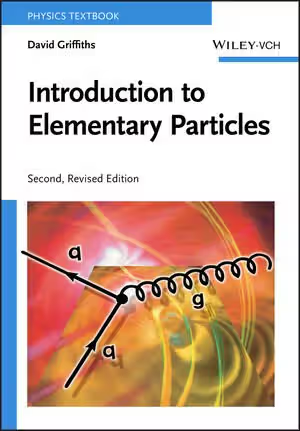
Griffiths, D. (2008). Introduction to Elementary Particles (2nd, rev. ed.). Wiley-VCH.
Chapter Summary
The book has an introduction, twelve chapters and four appendices (the Dirac delta function, decay rates and cross sections, Pauli and Dirac matrices, and the tree-level Feynman rules), in about 470 pages. The publisher describes the plan as a historical first chapter followed by a quantitative presentation of the Standard Model, with worked examples and many end-of-chapter problems.
Chapter 1: Historical Introduction to the Elementary Particles
Eleven sections run from the classical era (1897–1932) through the photon, mesons, antiparticles, neutrinos and strange particles to the Eightfold Way, the quark model, the "November Revolution" of 1974, the intermediate vector bosons and the Standard Model. The sample chapter calls itself a "folk history" and advises reading it quickly as background to the rest of the book.
Chapter 2: Elementary Particle Dynamics
A qualitative survey of the four forces, quantum electrodynamics, quantum chromodynamics and weak interactions (neutral and charged), followed by decays and conservation laws and a section on unification schemes. It gives the vocabulary that the calculational chapters later make precise.
Chapter 3: Relativistic Kinematics
Lorentz transformations, four-vectors, energy and momentum, and classical and relativistic collisions, ending with examples and applications.
Chapter 4: Symmetries
Symmetries, groups and conservation laws; angular momentum, including addition of angular momenta and spin; flavor symmetries; and the discrete symmetries parity, charge conjugation, CP (neutral kaons and CP violation) and time reversal with the TCP theorem.
Chapter 5: Bound States
Starting from the Schrödinger equation, the chapter treats hydrogen (fine structure, the Lamb shift, hyperfine splitting), positronium, quarkonium (charmonium, bottomonium), light quark mesons and baryons, including baryon wave functions, magnetic moments and masses.
Chapter 6: The Feynman Calculus
Decay rates and cross sections, the golden rule for decays and for scattering, and the Feynman rules for a "toy theory" in which the calculational techniques can be practised, up to higher-order diagrams.
Chapter 7: Quantum Electrodynamics
The Dirac equation and its solutions, bilinear covariants, the photon, the Feynman rules for QED, examples, Casimir's trick, cross sections and lifetimes, and renormalization.
Chapter 8: Electrodynamics and Chromodynamics of Quarks
Hadron production in e⁺e⁻ collisions, elastic electron–proton scattering, the Feynman rules for chromodynamics, colour factors, pair annihilation in QCD and asymptotic freedom.
Chapter 9: Weak Interactions
Charged leptonic weak interactions, the decays of the muon, neutron and pion, charged weak interactions of quarks, neutral weak interactions, and electroweak unification (chiral fermion states, weak isospin and hypercharge, electroweak mixing).
Chapter 10: Gauge Theories
From the Lagrangian formulation of classical mechanics to relativistic field theory, local gauge invariance, Yang–Mills theory, chromodynamics, the mass term, spontaneous symmetry breaking and the Higgs mechanism.
Chapters 11–12: Neutrino Oscillations; Afterword: What's Next?
The publisher lists chapters on neutrino oscillations and on prospects beyond the Standard Model as new to the second edition. Chapter 11 covers the solar neutrino problem, oscillations, their confirmation, neutrino masses and the mixing matrix. Chapter 12 looks ahead to the Higgs boson, grand unification, matter–antimatter asymmetry, supersymmetry, strings and extra dimensions, and dark matter and dark energy.
Key Concepts
Chapters 1–2: Historical Introduction; Elementary Particle Dynamics
- Quark model and Eightfold Way: the classification of hadrons that Chapter 1 builds toward.
- Four forces: the electromagnetic, strong, weak and gravitational interactions surveyed in Chapter 2.
- Conservation laws in decays: the rules that restrict which decays occur.
Chapters 3–5: Kinematics, Symmetries, Bound States
- Four-vectors: relativistic energy and momentum treated as components of one quantity.
- Discrete symmetries: parity, charge conjugation, CP and time reversal, with CP violation in neutral kaons.
- Quarkonium and baryon wave functions: bound states of quarks and what they reveal about the quark model.
Chapters 6–8: Feynman Calculus, QED, Quark Interactions
- Golden rule: the formula that turns amplitudes into decay rates and cross sections.
- Feynman rules: the diagrammatic recipe, introduced first for a toy theory and then for QED and QCD.
- Renormalization and asymptotic freedom: how couplings depend on scale in QED and QCD.
Chapters 9–12: Weak Interactions, Gauge Theories, Neutrinos
- Electroweak unification: weak isospin, hypercharge and mixing.
- Higgs mechanism: mass generation through spontaneous symmetry breaking.
- Neutrino oscillations and the mixing matrix: the evidence for neutrino mass.
Critical Analysis
Strengths
- A clear division of labour between history and calculation. The sample chapter says openly that it is background to be read quickly, and the remaining chapters then proceed to quantitative work. A reader can take the historical orientation without it delaying the technical material.
- A gentle route into Feynman rules. The publisher highlights a simplified introduction to the Feynman rules based on a toy model, so the calculational techniques can be learned without the complications of spin. Chapter 6 supplies this before QED in Chapter 7.
- Coverage of the full Standard Model sequence. The contents move from QED to the strong interaction, the weak interaction, gauge theories and the Higgs mechanism, and add neutrino oscillations; the appendices collect the delta function, Dirac matrices and Feynman rules for reference.
- Worked examples and many problems. The publisher stresses both; instructors can obtain a complete solutions manual.
Limitations
- Dated in places. The text predates the observation of the Higgs boson; Section 12.1 treats it as a prospect, and the sample chapter notes that only Fermilab could then produce top quarks until the LHC began operating. A current reader will need a newer source for these results.
- Solutions are for instructors. The solutions manual is available to registered instructors, so students working alone have no worked solutions to check against.
- Limited scope. The contents have no chapters on nuclear structure, so the book does not serve as a combined nuclear and particle text.
- Prerequisites not stated by the publisher. The publisher's page does not list prerequisites. The contents show reviews of relativistic kinematics (Chapter 3) and angular momentum (Chapter 4), but the Dirac equation and Chapters 6–10 require comfort with quantum mechanics.
Where It Fits in the Course
Griffiths is the calculational undergraduate text for particle physics in this course list. Frank Close's Particle Physics: A Very Short Introduction is a non-mathematical overview, and Dodd and Gripaios's The Ideas of Particle Physics is a concise introduction to the Standard Model for readers with a science background, using some mathematics but no heavy formalism; either makes a good preview of Chapters 1–2. Martin and Shaw's Nuclear and Particle Physics: An Introduction combines both subjects at an undergraduate level, and Krane's Introductory Nuclear Physics is the book to turn to for nuclear structure, decay and reactions, which Griffiths does not cover.
How to Use This Book
The book suits students who have completed a course in quantum mechanics and have seen special relativity; Chapters 3 and 4 refresh kinematics and angular momentum but are not a substitute for those courses. Appendices A and C collect the delta function and the Pauli and Dirac matrices that the later chapters use.
A reading plan for a one-term course: skim Chapter 1 quickly, as its author advises; read Chapter 2 for the overall picture; use Chapters 3–5 selectively, giving priority to the symmetry and quark-model material in Chapters 4 and 5; and make Chapters 6–10 the core, in order, since each uses the Feynman rules of the one before. Chapters 11 and 12 can be read for current context or left as optional. Work the problems alongside the text, because the techniques in Chapters 6–9 are learned by calculating.