01 / Reading Guide
Reading Guide
Citation
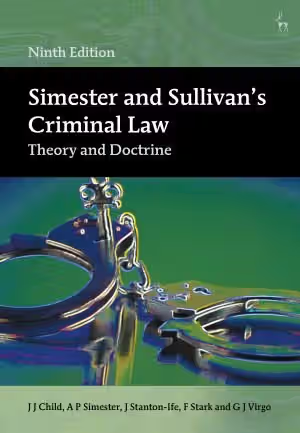
Child, J. J., Simester, A. P., Stark, F., Virgo, G. J., & Stanton-Ife, J. (2026). Simester and Sullivan's Criminal Law: Theory and Doctrine (9th ed.). Hart Publishing.
Chapter Summary
The ninth edition has twenty-two chapters. The publisher describes the book as an account of modern English criminal law that combines detailed exposition and analysis of the law with a careful exploration of its theoretical underpinnings; it is written primarily for undergraduate students and covers all subjects taught at that level. The order of the chapters is distinctive: the general part comes first, the principal offences follow, and the defences come last, after a chapter on the moral limits of criminalisation.
Chapters 1–3: Criminal Law: Definition and Ambit; The Rule of Law and the European Convention on Human Rights; Interpretation and Proof
The opening chapters concern the nature and boundaries of the criminal law, the rule of law and the European Convention on Human Rights, and interpretation and proof. They provide the constitutional and methodological setting for what follows.
Chapters 4–6: The Actus Reus; Mens Rea; Strict and Constructive Liability
The core of the general part: the conduct element, the mental element, and the forms of liability that depart from the usual requirement of fault.
Chapters 7–9: Secondary Participation; Vicarious and Corporate Liability; The Inchoate Offences
These chapters extend liability beyond the principal offender who completes the offence: participation by others, liability for the acts of others and of corporations, and attempts and other inchoate offences.
Chapters 10–13: Homicide; Non-Fatal Offences Against the Person; The Principal Sexual Offences; Theft
The specific offences begin with homicide, then non-fatal offences against the person, the principal sexual offences and theft.
Chapters 14–16: Related Offences; Fraud; The Moral Limitations of Criminalisation
Chapter 14 covers related offences, and Chapter 15 fraud. Chapter 16 steps back from the specific offences to the moral limits of criminalisation, the theoretical question of what the criminal law should and should not prohibit.
Chapters 17–22: Defences: An Overview; Failure of Proof; Irresponsibility Defences; Defences of Circumstantial Pressure; Permissible Conduct; Defences and Blame: Some Observations
Six chapters on defences. Chapter 17 gives an overview, Chapter 18 deals with failure of proof, Chapter 19 with irresponsibility defences, Chapter 20 with defences of circumstantial pressure and Chapter 21 with permissible conduct. The last chapter offers concluding observations on defences and blame.
Key Concepts
The general part (Chapters 1–9)
- Rule of law and the Convention: the constitutional setting of Chapter 2.
- Interpretation and proof: Chapter 3.
- Actus reus and mens rea: the conduct and mental elements, Chapters 4 and 5.
- Strict and constructive liability: liability that departs from ordinary fault requirements, Chapter 6.
- Secondary participation, vicarious and corporate liability, inchoate offences: Chapters 7 to 9.
Offences (Chapters 10–16)
- Homicide, non-fatal and sexual offences, theft and fraud: the principal offences of Chapters 10 to 15.
- Moral limits of criminalisation: Chapter 16.
Defences (Chapters 17–22)
- Failure of proof: Chapter 18.
- Irresponsibility defences, circumstantial pressure and permissible conduct: the three families of defences in Chapters 19 to 21.
Critical Analysis
Strengths
- Theory and doctrine together. The subtitle states the aim, and the publisher says the philosophical approach gives students a deeper understanding that goes beyond purely doctrinal knowledge. Chapters 2, 3 and 16 and the closing discussion of defences and blame are places where the book steps back to principle.
- Full treatment of the general part. Chapters 4 to 9 take actus reus, mens rea, strict and constructive liability, secondary participation, vicarious and corporate liability and inchoate offences in turn, and the defences receive six chapters of their own.
- Regularly updated. The publisher states that the ninth edition covers all statutory law including the Police, Crime, Sentencing and Courts Act 2022, the Online Safety Act 2023 and the Public Order Act 2023, with case law discussion that includes R v Iqbal (2023) and Auriol Grey (2024).
- Established reputation. The publisher says that over its numerous editions it has become required reading for criminal law courses.
Limitations
- Theory is part of the load. The publisher's emphasis on a philosophical approach means the book asks the reader to evaluate rules as well as learn them; a student who needs only a short statement of the rules for revision may prefer a shorter textbook for that purpose.
- Selective coverage of specific offences. The offences chapters are limited to homicide, non-fatal offences, the principal sexual offences, theft, related offences and fraud, so a course that also teaches, for example, public order or drugs offences will need other materials.
- Defences come late. Because defences occupy the last six chapters, a course that teaches them early will need to read out of order.
Where It Fits in the Course
Simester and Sullivan is the one that pairs doctrine with theory, among several criminal law texts on the list. Criminal Law (2024) is an undergraduate introduction covering the history of the subject, principles of liability, the main offences, strict and corporate liability, defences and inchoate offences with practical examples, and Ashworth's Principles of Criminal Law is a well-known undergraduate guide that also deals with principles and sentencing; either is a natural first book before this one. Crime, Reason and History is a critical introduction that stresses historical development and the political character of legal doctrine, a different kind of critique from this book's principled analysis. Reconstructing Criminal Law is a graduate-level casebook that integrates historical, sociological and theoretical perspectives through extracts.
Reach for this book after a first course, when essays and dissertations ask whether a rule can be justified, as well as what it is.
How to Use This Book
The book suits undergraduates taking criminal law beyond the first course or writing dissertations, postgraduates on criminal law courses, and anyone who wants a doctrinal treatment that engages closely with theory. A completed first course in criminal law is the sensible starting point.
A practical plan:
- Core: Chapters 1–9 for the general part, the elements and the extensions of liability.
- Offences: Chapters 10–15, according to the offences on the syllabus.
- Defences: Chapters 17–22 as a unit; start with the overview in Chapter 17.
- Theory: Chapter 16, and the discussion of defences and blame in Chapter 22, for essays on principle.
Consult chapters alongside the main textbook for the course, and use the theoretical discussion to build the evaluative part of an essay.