01 / Reading Guide
Reading Guide
Citation
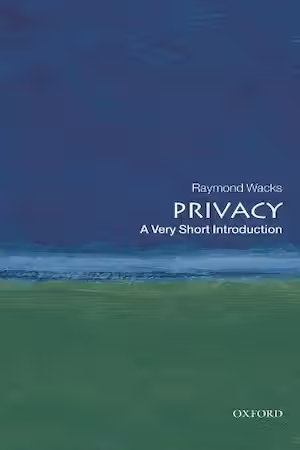
Wacks, R. (2010). Privacy: A Very Short Introduction. Oxford University Press.
Chapter Summary
This is a 176-page pocket-sized book in Oxford's Very Short Introductions series, with six chapters. The publisher describes it as a survey running from electronic surveillance, biometrics, CCTV, ID cards, RFID codes, online security, employee monitoring and DNA, through the tension between free speech and privacy, to the future of privacy. The author, Raymond Wacks, is an emeritus professor of law and legal theory at the University of Hong Kong who has written on privacy for more than three decades. The book is written from a position: privacy is a fundamental value under pressure, and clearer thinking is needed to protect it.
Chapter 1: The Assault
Opens with the contemporary threats to privacy: state and commercial surveillance, wiretapping and interception, CCTV, biometrics, RFID tagging, databases, identity theft and online tracking. The chapter sets up the question that follows, which is what exactly is being threatened and why it matters.
Chapter 2: An Enduring Value
Steps back from technology to ask why privacy has been valued and how it can be defined. It considers privacy as a human value that is not confined to one era or culture, and discusses the difficulty of pinning down a concept that is used for many different interests. This chapter lays the philosophical ground for the author's preference for treating personal information as the core of privacy.
Chapter 3: A Legal Right
Turns to the law. It compares the American approach, in which privacy is bound up with constitutional liberty and autonomy (with Brandeis's early advocacy and decisions such as Roe v Wade among the reference points), with European approaches built on human rights and data protection. It also considers the private-law claims that arise from intrusion and from disclosure of private facts, and asks how far a single legal right to privacy is workable.
Chapter 4: Privacy and Free Speech
Examines the conflict between press freedom and the protection of private life, with cases involving celebrities and the media (the index names Naomi Campbell and Catherine Zeta-Jones, among others). The chapter asks how courts weigh public interest against intrusion by newspapers, paparazzi photography and the disclosure of intimate details.
Chapter 5: Data Protection
Deals with the regulation of personal information: the position of the data subject and the data user, the principles of data protection regimes, and the role of regulators such as privacy commissioners. The treatment is mainly European, with the American approach as the contrast, and covers technological safeguards such as encryption.
Chapter 6: The Death of Privacy?
Concludes by asking whether privacy is disappearing or merely changing form, and what law, technology and public attitudes can do. The author's conclusion is that privacy remains an essential value that deserves continuing protection.
Key Concepts
Chapters 1–2: The Assault; An Enduring Value
- Surveillance: monitoring of individuals by states and private bodies through CCTV, interception, biometrics and RFID.
- Privacy as a value: the claim that privacy matters independently of any one legal rule, and the difficulty of defining it.
Chapters 3–4: A Legal Right; Privacy and Free Speech
- Constitutional privacy: the American line of cases in which privacy is tied to liberty and personal autonomy.
- Private-law claims: actions for intrusion and for public disclosure of private facts.
- Free speech versus privacy: the balance between public interest in information and the individual's interest in being left alone.
Chapters 5–6: Data Protection; The Death of Privacy?
- Data protection: legal rules governing the collection, use and disclosure of personal data, the position of the data subject, and oversight by regulators.
- Informational privacy: control over personal information, the strand of privacy on which the author focuses.
Critical Analysis
Strengths
- A specialist's compact overview. The author has worked on privacy for decades, and the book covers technology, philosophy, comparative law, press freedom and data protection in six short chapters. This breadth suits a reader who needs orientation before choosing a narrower text.
- A clear organising question. The sequence moves from threats (Chapter 1), to value (Chapter 2), to legal protection (Chapter 3), to the main conflicting interest (Chapter 4), to regulation (Chapter 5) and to the future (Chapter 6), which gives a beginner a map of the field.
- Comparative framing. Setting American constitutional privacy beside European data protection and human rights law helps students see why legal systems protect different interests under the same name.
- Readable and reviewed as such. Bookseller-quoted reviews describe the author as an erudite and persuasive advocate and the book as small but dense.
Limitations
- A committed viewpoint. The author argues for a particular approach, so the book is an argument as much as a neutral survey. Other accounts of privacy should be read as well.
- Short and dated. At 176 pages it can only sketch each area, and it was published in 2010; the technologies, cases and data protection law have changed greatly since then. A second edition appeared in 2015 with the chapters retitled, so check which edition you hold.
- Not a doctrinal text. It will not teach the detailed English law of misuse of private information or the Human Rights Act case law needed for exams.
Where It Fits in the Course
Within this course list, Merris Amos's Human Rights Law is a textbook on human rights law in the United Kingdom, built around the Human Rights Act and the Convention. Harris, O'Boyle and Warbrick's Law of the European Convention on Human Rights is a detailed scholarly account of the Convention rights through the Strasbourg case law. Conor Gearty's Civil Liberties and Liberty and Security treat civil liberties and the balance between liberty and security, and On Fantasy Island discusses the Human Rights Act in its political context. Kai Möller's The Global Model of Constitutional Rights and Aileen Kavanagh's The Collaborative Constitution are works on how rights are adjudicated and protected.
Wacks is the topic-specific, accessible entry. It is best read first, in a single sitting or two, to see why privacy is contested, and then used as background when a course turns to Article 8 or to data protection.
How to Use This Book
The book suits first-year or non-specialist readers; no legal background is required. Read it straight through, because the chapters build on each other. If time is short, Chapters 3 and 5 give the legal core, and Chapter 4 is useful for anyone studying media law or freedom of expression.
Use it alongside the primary materials: after Chapter 3, read the main decisions on Article 8 in a human rights textbook; after Chapter 5, look at the current data protection statute and regulator guidance. Treat the author's own position as one view and test it against other readings.