01 / Reading Guide
Reading Guide
Citation
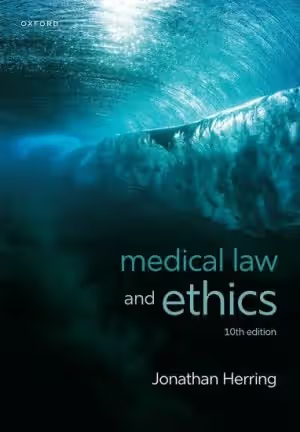
Herring, J. (2025). Medical Law and Ethics (10th ed.). Oxford University Press.
Chapter Summary
The book has eleven chapters and runs to about 740 pages. Oxford University Press describes it as covering the core legal principles, key cases and statutes of medical law alongside the key ethical debates and dilemmas in the field. Its order runs from ethics and the health service, through negligence, consent and the special position of children and of mental health, to confidentiality, reproduction, the body and death.
Chapter 1: Ethics and Medical Law
The first chapter takes up the relationship between ethics and medical law. The publisher says the book presents the law alongside a range of ethical perspectives.
Chapter 2: The Structure of the National Health Service and the Rationing of Healthcare Resources
This chapter deals with how the National Health Service is organised and with the allocation, or rationing, of healthcare resources.
Chapter 3: Medical Negligence
The chapter covers the law of medical negligence. The publisher lists the developing law on medical negligence among the updates in the 10th edition.
Chapter 4: Consent to Treatment
This chapter covers consent to medical treatment, followed by chapters on children and on mental health law.
Chapters 5–6: Children and Medicine; Mental Health Law
Chapter 5 deals with children and medicine, including, according to the publisher, developments in the law on trans and gender-questioning youth. Chapter 6 deals with mental health law; the publisher lists coverage of the Mental Health Bill introduced to Parliament in 2024.
Chapter 7: Confidentiality
This chapter examines the duty of confidentiality in the relationship between patient and health professional.
Chapters 8–9: Contraception, Abortion and Pregnancy; Reproduction
These two chapters cover the law on contraception, abortion and pregnancy and then on reproduction. The publisher notes extended discussion of disability and abortion.
Chapters 10–11: Organ Donation and the Ownership of Body Parts; Dying and Death
The last chapters concern the use and ownership of the body, through organ donation and body parts, and the end of life. The publisher lists new coverage of the Assisted Dying Bill 2024.
Key Concepts
Chapters 1–4: Ethics, Resources, Negligence and Consent
- Ethics and medical law: the connection between moral argument and legal rules that frames the book (Chapter 1).
- Rationing of healthcare resources: the allocation of limited health service resources (Chapter 2).
- Medical negligence: liability for substandard medical care (Chapter 3).
- Consent to treatment: the requirement of patient consent (Chapter 4).
Chapters 5–11: Particular Patients and Issues
- Children and medicine and mental health law: the law applying to patients in these groups (Chapters 5 and 6).
- Confidentiality: the protection of patient information (Chapter 7).
- Reproduction: contraception, abortion, pregnancy and reproduction (Chapters 8 and 9).
- Organ donation and body parts, and dying and death: the last topics in the book (Chapters 10 and 11).
Critical Analysis
Strengths
- Features that open up the debates. The publisher says that features throughout the text draw attention to diverging opinions, including religious, feminist and European perspectives, and lists boxes called 'a shock to the system', 'public opinion' and 'reality check' that bring in socio-legal discussion.
- Law and ethics together. The publisher presents the book as a concise text giving both discussion of the law and an overview of the ethical perspectives, so that readers understand the law and its context.
- A compact structure. The contents list covers the usual medical law topics (negligence, consent, children, mental health, confidentiality, reproduction, organs and end of life) in eleven chapters.
- Recent updates. The 10th edition's listed updates include the Assisted Dying Bill 2024, the Mental Health Bill 2024, developments on trans and gender-questioning youth, medical negligence, disability and abortion, and the use of artificial intelligence in medicine.
Limitations
- England and Wales focus. The updates the publisher names (the Assisted Dying Bill, the Mental Health Bill) are UK measures, so students elsewhere will need local material.
- Bills date quickly. Several of the updates are proposed legislation, whose status will change after publication, so the discussion needs checking against current law.
- No chapter on research. The contents list has no chapter titled for medical research or clinical trials, whereas Pattinson's list has two chapters on research.
Where It Fits in the Course
Herring's Medical Law and Ethics is a main course textbook for a full medical law course. The most direct alternative in this list is Shaun Pattinson's single-author Medical Law and Ethics (7th edition), which has seventeen chapters, spreads consent, transplantation and end of life across two or three chapters each, includes chapters on research, and ends with a chapter on a moral approach to medical law. Herring's list is shorter, with eleven chapters.
For a first look, Charles Foster's Medical Law: A Very Short Introduction asks whether patient autonomy should dominate the way the subject is framed, and Margaret Brazier, Emma Cave and Rob Heywood's Medicine, Patients and the Law is an accessible survey for students and general readers. At the other end, Mason & McCall Smith's Law and Medical Ethics (edited by Anne-Maree Farrell and Edward Dove) is a long-established account that also covers Scots law, and Emily Jackson's Medical Law: Text, Cases, and Materials combines commentary with extracts of primary material, as its title indicates.
How to Use This Book
The book is intended for law students taking a medical law course. A first-year law background is useful for reading the cases and statutes; the publisher describes the book as giving an overview of the ethical perspectives, so no earlier study of ethics seems to be required.
A practical plan:
- Core: Chapter 1, then Chapters 3 and 4 (medical negligence and consent), the central topics.
- Context and resources: Chapter 2 on the health service and rationing, ahead of or alongside negligence.
- Particular topics: Chapters 5–11 in the order the syllabus takes them.
Use the debate features to prepare essay answers and compare the arguments with those in the other books of the list. Where the book discusses bills, check the current position.