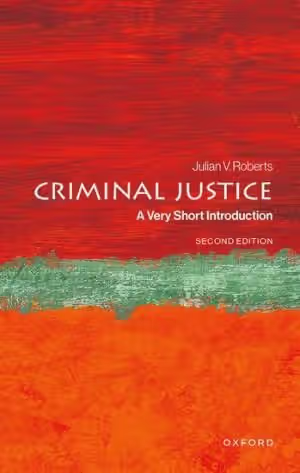
01 / Reading Guide
Reading Guide
Citation
Roberts, J. V. (2026). Criminal Justice: A Very Short Introduction (2nd ed.). Oxford University Press.
Chapter Summary
The second edition (June 2026) is a pocket book of about 160 pages: a preface to the second edition, six chapters, an appendix reproducing an extract from a Court of Appeal judgment with commentary, and further reading with chapter references and additional resources. Julian V. Roberts is Emeritus Professor of Criminology at the University of Oxford, was a member of the Sentencing Council for England and Wales from 2010 to 2018, and advised on the American Law Institute's Model Sentencing Code. The publisher describes the book as covering every stage of the system, from crime to courthouse and from prison to parole, with a focus on the adversarial model and a critical examination of the modern justice system. New material covers artificial intelligence, the recognition that criminal justice affects visible and ethnic minorities differently, and international legal disputes. The first edition (2015) had seven chapters, including a separate chapter on crime victims; in the second the victim's role is among the questions the publisher says the book addresses, and the final chapters are restructured.
Chapter 1: The origins and key features of criminal justice
The opening chapter, about twenty pages, introduces the system as a whole. In the first edition the corresponding chapter set out the objectives of criminal justice, its key principles, the contrast between the adversarial and inquisitorial models, the components of the system from police to parole, discretion, and the forms that criminal injustice can take.
Chapter 2: Between the crime and the court
What happens after a crime and before trial. The first-edition chapter of the same name covered out-of-court disposals, the decision to charge, bail and remand, plea bargaining and sentence reductions for guilty pleas; these terms recur in the new edition.
Chapter 3: Inside the criminal courts
The trial stage. The first edition's equivalent ("In court and on trial") discussed judges and juries, how prosecutors and judges are appointed or elected, specialist problem-solving courts, and wrongful convictions and acquittals. Jury nullification and wrongful convictions are among the terms that recur in the second edition.
Chapter 4: Why punish . . . and how?
The longest chapter, at nearly thirty pages, reflecting the author's specialism in sentencing. In the first edition this chapter set out the justifications for punishment, looking back to the seriousness of the crime and forward to preventing future offending, and covered proportionality, deterrence, rehabilitation, sentencing guidelines, aggravating and mitigating factors, and the main sentencing options.
Chapter 5: In and out of prison
Imprisonment and release. The first-edition chapter covered the prison population, the costs and "pains" of imprisonment, release and parole, life after release, reoffending, and alternatives such as electronic monitoring.
Chapter 6: The future of criminal justice
A short closing chapter of about five pages on where criminal justice is heading.
Appendix: Extract from Court of Appeal judgment and commentary: the case of "Ms Barrett"
An extract from an appellate judgment with the author's commentary, giving the reader a direct look at how a court reasons about a case.
Key Concepts
The system and its stages (Chapters 1–3)
- Adversarial model: the contest between prosecution and defence before a neutral decision-maker, the model on which the book focuses.
- Inquisitorial model: the contrasting model in which the court leads the investigation of the case.
- Discretion: the choices that police, prosecutors and judges make at each stage.
- Plea bargaining and guilty pleas: the negotiation that can resolve a case without a full trial.
- Wrongful convictions: the most visible form of criminal injustice.
Punishment (Chapters 4–5)
- Purposes of sentencing: retributive and preventive justifications, including proportionality, deterrence and rehabilitation.
- Sentencing guidelines: structured guidance, such as that issued by the Sentencing Council, on how to set a sentence.
- Parole and release: the decision to release prisoners before the end of their sentence, and life after release.
Developments (Chapter 6)
- Artificial intelligence: a new subject in this edition, in the context of how criminal justice may change.
- Differential impact: the uneven effect of criminal justice on visible and ethnic minorities.
Critical Analysis
Strengths
- The whole process in one short book. The chapters follow a case through the system in order, from the period between crime and court to trial, sentence, prison and release, which gives newcomers a clear map of how the stages connect.
- Written by a sentencing specialist. Roberts's research career and his service on the Sentencing Council show in the weight given to punishment and sentencing, the longest chapter.
- Comparative. The book contrasts the adversarial and inquisitorial models, and its recurring examples (England and Wales, Canada, the United States, other common law countries) let readers see how jurisdictions differ.
- Up to date and primary-source contact. The second edition adds AI, racial disparity and international disputes, and its appendix puts an actual Court of Appeal judgment in front of the reader.
Limitations
- Very brief. At about 160 pages, each topic is introduced rather than examined in depth, and the closing chapter is only about five pages.
- Victims less prominent in the structure. The first edition's separate chapter on crime victims no longer appears as a chapter title; readers interested in victims' rights and restorative justice should check how far the second edition covers them, or turn to a sentencing text.
- Not a law textbook. The book explains the system and its policy questions rather than the rules of criminal law, evidence or procedure, so law students will need doctrinal texts for those.
Where It Fits in the Course
This is the shortest and most accessible entry point to the criminology and criminal justice books on this list, and a good first read before a course begins. Tim Newburn's Criminology and The Oxford Textbook on Criminology by Steve Case and co-authors are full course textbooks that cover theories of crime, measurement and the institutions of the system; this book is a preview of their criminal justice chapters and a concise review of the stages afterwards. The Oxford Handbook of Criminology collects survey chapters by specialists on theory, research and policy, and is the place to go for depth on any topic introduced here.
Stephen Easton and co-authors' Sentencing and Punishment: The Quest for Justice is a more advanced study of penal policy, sentencing principles, victims' rights, imprisonment and rehabilitation; it develops Chapters 4 and 5 at length and covers the victim questions that this edition no longer treats in a separate chapter. Richard English's Terrorism: How to Respond addresses a specialised area of state response to political violence and is best read once the general system is familiar.
How to Use This Book
The book is written for general readers as well as students, and assumes no prior knowledge of law or criminology. It suits first-year students in criminology, law and social policy, and anyone who wants to understand how criminal justice works before studying it in detail.
A practical approach:
- Read it straight through. The chapters follow the order of a case through the system, so the book works best read in sequence; it can be finished in two or three sittings.
- Concentrate on Chapter 4. Sentencing is the book's longest and most developed topic. Note each purpose of punishment and the arguments for and against it; these recur throughout a criminology or penology course.
- Use the appendix actively. Read the Court of Appeal extract before the commentary, decide what you think the court should have done, then compare with the author's analysis.
- Follow the further reading. The chapter references and additional resources at the end are the bridge to the textbooks and the research literature.
After this book, move to a full textbook such as Newburn or the Oxford textbook for theory and institutions, and to Easton and co-authors for sentencing and punishment in depth. Because criminal justice policy changes quickly, check current statistics and sentencing guidelines from official sources when using the book's examples in coursework.