01 / Reading Guide
Reading Guide
Citation
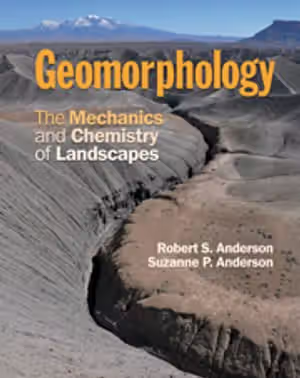
Anderson, R. S., & Anderson, S. P. (2010). Geomorphology: The Mechanics and Chemistry of Landscapes. Cambridge University Press.
Chapter Summary
The book has eighteen chapters and two appendices, running to about 640 pages including references and index. The authors say they arranged it from large scale to small scale: first the shape of the whole Earth and the geophysics that builds topography, then tools for dating and for understanding the atmosphere, then the processes that wear landscapes down. Every chapter ends with a summary, problems and further reading.
Chapters 1–3: Introduction to the Study of Surface Processes; Whole Earth Morphology; Large-Scale Topography
Chapter 1 sets out the guiding principles: conservation, transport rules, and event size and frequency, along with what drives geomorphic processes. Chapter 2 asks why the Earth is an oblate spheroid and examines its hypsometry. Chapter 3 covers ocean basins (conduction and isostasy), plate tectonics, orogens, mantle response times and dynamic topography.
Chapters 4–6: Tectonic Geomorphology; Atmospheric Processes and Geomorphology; Dating Methods, and Establishing Timing in the Landscape
Chapter 4 links faults and landforms through fault scaling, paleoseismology, marine platforms, river profiles and flexure. Chapter 5 reviews the Sun, radiation, atmospheric circulation, monsoons and orographic effects. Chapter 6 surveys relative and absolute dating, with extended treatment of cosmogenic radionuclides and of thermochronometry.
Chapters 7–9: Weathering; Glaciers and Glacial Geology; Periglacial Processes and Forms
Chapter 7 treats the weathered profile and the Critical Zone, the processes that fracture rock, chemical equilibrium and kinetics, and the conversion of bedrock to mobile regolith. Chapter 8 covers glaciology (mass balance, ice deformation, Glen's flow law, sliding), glacial erosion and the resulting landforms. Chapter 9 turns to permafrost, its thermal structure, frost heave, patterned ground, ice wedges and thermokarst.
Chapters 10–12: Hillslopes; Water in the Landscape; Rivers
Chapter 10 develops hillslope mass balance and diffusive processes, then landslides, debris flows and hillslope models. Chapter 11 follows water through drainage basins, soil moisture, infiltration, groundwater and runoff mechanisms, and discusses drainage density and channel heads. Chapter 12 starts from turbulent flow in open channels and moves to hydraulic geometry, floods, braided and meandering channels and long profiles, with an appendix on the Navier–Stokes equation.
Chapters 13–15: Bedrock Channels; Sediment Transport Mechanics; Eolian Forms and Deposits
Chapter 13 covers erosion processes in bedrock rivers, stream profiles and the channel width problem. Chapter 14 looks at grain entrainment, modes of transport and transport laws. Chapter 15 covers dunes, ripples, loess, erosion by windblown particles and windblown snow.
Chapters 16–18: Coastal Geomorphology; The Geomorphology of Big Floods; Whole Landscapes
Chapter 16 covers sea level change, waves, sand movement and sandy, rocky and icy coasts. Chapter 17 collects the evidence for very large floods, including the Bonneville and Missoula floods. Chapter 18 applies the whole toolkit to the Santa Cruz landscape, from terraces and rock uplift to sea-cliff evolution. Appendix A summarises physics (units, heat transport, rheologies, dimensionless numbers) and Appendix B mathematics.
Key Concepts
Chapters 1–6: Foundations
- Conservation of mass (continuity): the rate of change of storage equals inputs minus losses, the template the authors apply from chapter to chapter.
- Isostasy: the buoyant balance of the crust on the mantle, introduced with ocean basins.
- Cosmogenic radionuclides: isotopes produced in surface rock by cosmic rays, used to date exposure and measure erosion rates.
Chapters 7–12: Weathering, Ice, Slopes and Rivers
- Critical Zone: the near-surface layer in which rock, water, soil and life interact.
- Glen's flow law: a relation describing how ice deforms under stress.
- Diffusive hillslope transport: the model behind convex hilltops.
- Hydraulic geometry: the systematic relationships among channel width, depth, velocity and discharge.
Chapters 13–18: Channels, Sediment, Coasts and Landscapes
- Stream power: the basis for modelling erosion by bedrock rivers.
- Sediment transport laws: relationships between flow strength and the flux of grains.
- Paleoflood analysis: reconstructing very large floods from deposits and landforms.
Critical Analysis
Strengths
- A single quantitative method. The preface describes setting up each problem as a statement of conservation of a quantity, and applying it repeatedly to hillslopes, glaciers, rivers and dating, which gives the book unusual unity.
- Support for the mathematics. The authors say they include steps in derivations and a mathematics appendix running from algebra through differential equations and probability distributions.
- Modern topics. Cosmogenic nuclide dating, thermochronometry and the Critical Zone get dedicated treatment, and the preface presents whole-Earth shape, big floods and a case-study chapter as deliberate novelties.
- Reader-friendly design. Boxed worked examples, real-world applications, a conversational tone and problems at every chapter's end are advertised by the publisher; reviewers quoted on the cover (Paola, Furbish, Wilcock, Hovius) praise its clarity and range.
Limitations
- Mathematically demanding. The preface says students must be comfortable with, or willing to accept the challenge of, a mathematical treatment.
- Process rather than landform catalogue. The authors state that attention falls on processes instead of cataloguing landforms, so readers wanting a descriptive survey will need another book.
- Unconventional order. The authors place the cold-environment chapters (glaciers, periglacial) before hillslopes and rivers, admitting that this reflects their own interests, and put geophysics ahead of the more familiar fluvial material, so a course may need to reorder chapters.
Where It Fits in the Course
Fundamentals of Geomorphology and Key Concepts in Geomorphology are broad introductory textbooks, and Landscapes and Geomorphology: A Very Short Introduction is a brief overview; any of them is a gentler first course. This book is the quantitative, process-based option for third- or fourth-year and early graduate study. Introduction to Physical Hydrology and Physical Hydrology cover the water side in more depth than Chapter 11 and are natural companions.
How to Use This Book
Intended readers are upper-level undergraduates and beginning graduate students in geography, geology and Earth science who are ready for derivations. Prior calculus and basic physics are helpful, and Appendix B can refresh the rest.
For a course, Chapter 1 is essential and the authors' conservation framework should be learned first. Chapters 7, 10, 11, 12 and 14 form the core of hillslope and river work; Chapters 2–6 can be selected according to interest in tectonics and dating. Chapters 8–9 (cold environments), 15–16 and 17 are suitable for choosing among. Chapter 18 is best read last as a synthesis. Work the problems at the end of chapters and read the boxed examples rather than skipping them.