01 / Reading Guide
Reading Guide
Citation
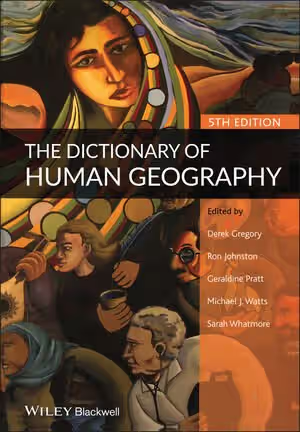
Gregory, D., Johnston, R., Pratt, G., Watts, M. J., & Whatmore, S. (Eds.). (2009). The Dictionary of Human Geography (5th ed.). Wiley-Blackwell.
Chapter Summary
This is a reference work of about 1,070 pages with no chapters in the usual sense: the main body is an alphabetical sequence of entries running from page 1 to page 817, followed by a consolidated bibliography (from page 818) and an index (from page 957). Wiley describes it as a guide to issues and ideas, methods and theories in human geography, revised to reflect the changing nature of the field and its connections with other fields. The headings below follow the book's structure and the areas that the publisher singles out as new or expanded in the fifth edition.
Front matter: Preface, How to Use This Dictionary, Contributors
Before the entries come the Preface to the Fifth Edition, a note on how to use the dictionary, acknowledgements, a list of contributors and an editorial advisory board. The "How to Use This Dictionary" section is worth reading once, because the book works through cross-referencing of headwords and a separate index, not through a linear narrative.
The Dictionary: major and short entries
Wiley distinguishes two kinds of entry. The major entries not only describe the development of concepts, contributions and debates in human geography but also advance them. Shorter, definitional entries give quick reference and cover the wider subject area. Specialist contributors write the entries, and the fifth edition adds contributors "at the forefront of developments in the field" and more than 300 key terms that appear for the first time.
New and expanded coverage: the discipline and its neighbours; world regions
The publisher says the fifth edition addresses human geography's relation to geography as a whole (including physical geography and biogeography) and its dialogue with the humanities and social sciences, naming international relations, literature, philosophy and social theory. It also traces the conceptual and cultural formation of major world regions: Africa, the Americas, Asia, Australasia, Europe, Latin America, the Middle East and the Global South.
New and expanded coverage: geopolitics, geo-economics, environment
Wiley lists expanded coverage of geopolitical and geo-economic issues, among them American empire, asylum, ethnic cleansing, the Cold War, genocide, human rights, the International Monetary Fund, just war, narco-capitalism, terrorism, petro-capitalism, urbicide, war and the World Social Forum. Ecological and environmental coverage is strengthened with entries including biodiversity, biosecurity, climate, global warming, sustainability, tropicality, urban nature and water.
New and expanded coverage: theory and methods
On theory, the publisher names affect, complexity theory, non-representational theory, posthumanism and spaces of exception. On method, it names digital cartography, geographical information science, methodology, software for quantitative and qualitative analysis and visual methods.
Bibliography and index
For the first time, the bibliography is consolidated at the end of the book (from page 818) instead of being scattered across entries. The index, which begins on page 957, is described in its own note as a guide to the interconnections within human geography: extensive sets of subheadings and a network of "see" and "see also" references point to alternative headings and related topics, page numbers in bold mark the main discussion of a topic, and references to individual authors are included only where their work is quoted or discussed in some detail.
Key Concepts
Concepts and positions listed in the index
- Core concepts: the index carries headings such as place, space, scale, nature, gender, race, empire, migration and capitalism, the vocabulary on which most human geography is built.
- Theoretical approaches: positivism and logical positivism, humanistic geography, realism, structuration theory, feminist geographies, Marxist geography and actor-network theory all appear as headings.
- Methods: geographical information science and cartography are among the areas the publisher says have been updated.
New in the fifth edition
- Affect, non-representational theory, posthumanism, spaces of exception: recent theoretical developments in the humanities and social sciences that the publisher names.
- Tropicality and urban nature: two of the environmental entries added or strengthened.
- Regional formations: entries tracing the conceptual and cultural formation of world regions.
Critical Analysis
Strengths
- Two kinds of entry. The combination of extended entries that advance debates and short definitional entries lets the book serve both a first lookup and a deeper reading. Wiley presents the major entries as contributions, not just summaries.
- Navigation aids. The index note describes subheadings, cross-references and bold page numbers for main discussions, and Wiley notes that systematic cross-referencing of headwords provides a second architecture beside the alphabetical order. This makes it possible to read around a concept instead of looking up a single term.
- A consolidated bibliography. Moving all references to a bibliography at the back makes it a resource in its own right for anyone building a reading list, as the publisher points out.
- Respected endorsements. The publisher quotes four scholars. Linda McDowell (Oxford) calls it essential for all human geographers, Gerard Toal (Virginia Tech) describes it as a conceptual map to contemporary thinking, Mei-Po Kwan (Ohio State) praises its balance of breadth and depth, and Noel Castree (Manchester) says there is no single-volume reference in the field to rival it. These are the publisher's selection of reviews.
Limitations
- Not designed for continuous reading. An alphabetical reference gives no learning sequence. A student new to the field needs a textbook alongside it, and the entries assume that basic terms are known.
- Scale and the back-of-book bibliography. At roughly 1,070 pages the book is large, and because the bibliography is consolidated (pages 818 to 956, before the index at 957), following up a citation always means turning to the back of the volume.
- Fixed at 2009. The edition predates later debates, so the most recent theoretical and political developments are absent.
- Many authors. Because many specialist contributors write the entries, tone and difficulty may differ from entry to entry.
Where It Fits in the Course
This is the reference shelf of the introductory human geography list, not a first reading. Dorrell and Henderson's Introduction to Human Geography is a comprehensive introduction covering population, culture, politics, economics and urbanization, Daley and Klinke's Human Geography: A Very Short Introduction is a concise current entry point, and Berglee and colleagues' World Regional Geography surveys the world's regions. The Dictionary sits beside them and is where a student looks up a term met in any of these books.
Aitken and Valentine's Approaches to Human Geography is its closest partner. That book presents philosophies, theories and practices in chapters; the Dictionary's index lists several of the same positions (positivism, humanistic geography, realism, structuration theory, feminist geographies, Marxist geography, actor-network theory) as headings, so a student can read a chapter and then consult the matching entry.
How to Use This Book
The Dictionary is for students who have started an introductory course in human geography and for researchers who need a quick, authoritative outline of a concept. Read the Preface and "How to Use This Dictionary" first, then use it by need.
A practical plan:
- When reading a textbook: look up each unfamiliar term, then follow the "see also" references to two or three related entries to see the idea in context.
- When starting an essay: begin from the entry on the concept, note the debates it describes, and use the consolidated bibliography at the back to find primary sources.
- When planning a literature search: use the index's subheadings to find where a topic is treated, and check the bold page numbers for the main discussion.
- To revise a field: read the major entries on one area, such as an environmental theme or a world region, in one sitting rather than alphabetically.