01 / Reading Guide
Reading Guide
Citation
Goodsell, D. S. (2009). The Machinery of Life (2nd ed.). Copernicus Books / Springer.
Chapter Summary
The second edition is a short illustrated book of about 170 pages (x + 167 pages in library records) in nine chapters. Its author, a molecular biology researcher and artist based at Scripps Research, built it around two kinds of pictures described in the original preface: paintings that magnify a small portion of a living cell about a million times to show the molecules packed inside, and images of individual molecules in atomic detail. According to the author's own page for the book, the second edition has full-colour illustrations updated with results from genomics and proteomics, including a new cross-section of an Escherichia coli cell and a new chapter on life and death.
Chapter 1: Introduction
A six-page opening chapter. The book's starting point, as the original preface puts it, is that the molecular world is separated from everyday experience by a millionfold difference in size, a gap the illustrations are meant to bridge. Tina Toni's review in Human Genomics singles out the comparisons that make the scale tangible, such as a protein in a cell being comparable to a grain of rice in a room.
Chapters 2–3: Molecular Machines; The Processes of Living
Together these chapters form the basic molecular biology and biochemistry the rest of the book relies on. The review describes them as covering molecules such as DNA, lipids and polysaccharides, and then how cells use them to build new proteins, obtain energy, protect themselves and communicate with their surroundings.
Chapter 4: Molecules in Cells: Escherichia coli
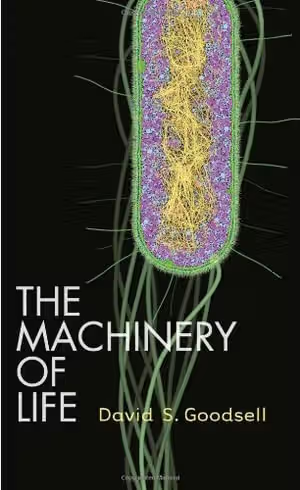
A tour of a bacterial cell, centred on the new cross-section of E. coli that also appears on the cover. With Chapter 5 it lets readers compare a prokaryotic cell with a eukaryotic one.
Chapter 5: A Human Cell: The Advantages of Compartments
The eukaryotic counterpart, organised around the idea in its title: what membranes and organelles allow a cell to do. The author's page mentions an updated panorama through a eukaryotic cell, running from the cell membrane to the nucleus.
Chapter 6: The Human Body: The Advantages of Specialization
The longest chapter (pp. 82–107) moves from single cells to the specialised cells of the body. The review lists the infrastructure inside cells and the communication between them that make possible muscle contraction, blood flow and the firing of nerves; the author's page highlights a view of the myelin sheath.
Chapter 7: Life and Death
The chapter new to this edition covers life and death at the molecular, cellular and whole-organism levels; the review mentions cancer, ageing and death.
Chapter 8: Viruses
A molecular introduction to viruses and the immune response, discussing HIV and the avian and swine influenza viruses, why vaccines sometimes work and sometimes fail, and why some infections are deadlier than others.
Chapter 9: You and Your Molecules
The closing chapter turns to health and everyday life, discussing the effects of vitamins, poisons and antibiotics on the body.
Key Concepts
Chapters 1–3: Scale and Molecular Machinery
- Molecular scale: the millionfold size difference between molecules and everyday objects, which the illustrations bridge by drawing at a consistent magnification.
- Molecular machines: proteins and other macromolecules treated as working parts that build proteins, obtain energy and carry signals.
- Molecular crowding: the dense packing of molecules inside a cell, which the cross-sectional paintings make visible.
Chapters 4–6: Cells and Bodies
- Prokaryotic and eukaryotic cells: E. coli and a human cell compared, showing what compartments add.
- Specialization: how cells in a multicellular body take on distinct jobs and communicate to coordinate them.
Chapters 7–9: Health and Disease
- Life and death at several scales: processes such as cancer and ageing traced from molecules to the whole organism.
- Viruses and immunity: how viruses infect cells, and the molecular basis of vaccines and of the body's defences.
Critical Analysis
Strengths
- Pictures drawn to a common scale. Toni's review points out that all the figures share a comparable scale, so readers can flip between pages to compare DNA, proteins, ribosomes, pores and organelles. The reviewer adds that the crowded cell interiors corrected the impression left by sparse signalling-pathway diagrams.
- Short and clear. The review credits clear, concise language and a short text that gives the basics while building intuition. The first-edition preface says the text was written for non-scientists while the illustrations were held to a standard that should satisfy a biochemist.
- Moves between scales. The reviewer singles out Chapters 6, 7 and 9 as the book's highlights for the way they zoom from molecular processes up to muscles, nerves, disease and ageing.
- Documented science behind the images. The author's page links a series of his articles in Biochemistry and Molecular Biology Education (2009–2012) explaining the science behind individual illustrations (E. coli, the mitochondrion, the eukaryotic cell panorama, viruses, the neuromuscular synapse), together with an errata list and reduced versions of the figures for presentations.
Limitations
- Not a textbook. The reviewer states plainly that the book is not a comprehensive manual or a textbook of molecular biology. It explains what molecules do without asking readers to follow every process in detail.
- Science as of 2009. The illustrations were updated for the second edition with results available at the time; structural knowledge that came later is not reflected.
- Little chemistry for a chemistry course. The book is written for general readers and builds visual intuition rather than chemical reasoning, so chemistry students will need a textbook for the content they are examined on.
Where It Fits in the Course
Among the biochemistry books on this list, Goodsell's is a picture book of the cell to read before or alongside a textbook, not instead of one. Mark Lorch's Biochemistry: A Very Short Introduction is the closest companion: a short prose introduction to how the molecules of life are built and transformed and how the discipline developed, whereas Goodsell shows where those molecules sit and how crowded the cell is.
For the course itself, introductory texts such as McKee and McKee's Biochemistry: The Molecular Basis of Life and Pratt and Cornely's Essential Biochemistry supply the structures, enzymes and metabolic pathways that Goodsell only pictures, and comprehensive references such as Lehninger Principles of Biochemistry and Berg and colleagues' Biochemistry take them much further. Kuriyan, Konforti and Wemmer's The Molecules of Life, which explains macromolecules through physical chemistry, is a much later step for students who want the physical principles behind the structures Goodsell paints.
How to Use This Book
The book suits students about to start biochemistry or cell biology, chemistry students meeting biological molecules for the first time, and anyone who wants an accurate picture of the inside of a cell. No specialist knowledge is needed; school biology and chemistry are enough to follow the text.
A practical plan:
- Before the course: read Chapters 1–5 in one or two sittings. They give a mental map of molecules, a bacterial cell and a human cell that makes textbook diagrams easier to place.
- Alongside the course: return to Chapter 6 when studying muscle contraction, blood flow and nerve signalling, and to Chapters 7–9 for cancer and ageing, viruses and immunity, and the effects of vitamins, poisons and antibiotics.
- While studying: compare sizes across illustrations, as the reviewer suggests, and when a textbook shows a single enzyme or pathway, find the corresponding crowded scene in Goodsell and locate the molecule in it.
- Going further: the author's Biochemistry and Molecular Biology Education articles explain how particular paintings were constructed and are a natural next read for students interested in structural biology. Check the errata list on the author's website.