01 / Reading Guide
Reading Guide
Citation
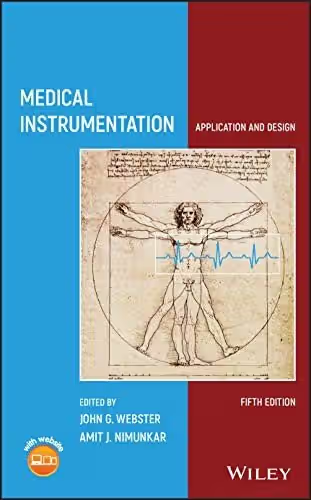
Webster, J. G., & Nimunkar, A. J. (Eds.). (2020). Medical Instrumentation: Application and Design (5th ed.). John Wiley & Sons.
Chapter Summary
The fifth edition is a multi-author reference textbook of fourteen chapters and a short appendix, about 850 pages in all. The publisher says it describes the principles, applications and design of the medical instruments most commonly used in hospitals, with great emphasis on design so that scientists with limited electronics backgrounds can learn to design instruments that may not be commercially available. The chapters are written by specialist contributors, and each ends with problems and references. The publisher lists new material on microcontroller-based instrumentation with code, device design with circuit simulations, dry electrodes for electrocardiography, a sleep apnea monitor, an infusion pump system, medical imaging techniques and electrical safety.
Chapter 1: Basic Concepts of Medical Instrumentation
Written by Walter H. Olson and John G. Webster, this is a long chapter of about ninety pages that sets the common framework. It covers medical terminology, the generalized instrumentation system (measurand, sensor, signal conditioning, display), operational modes, measurement constraints, interfering inputs and compensation, biostatistics, static and dynamic characteristics, and then operational amplifiers and active filters, ending with the commercial development process and the regulation of medical devices. The publisher's sample shows fifteen worked examples within the chapter, followed by problems and references.
Chapters 2–3: Basic Sensors and Principles; Microcontrollers in Medical Instrumentation
Chapter 2 (Robert A. Peura and Webster) surveys displacement, resistive, inductive, capacitive and piezoelectric sensors, bridge circuits, temperature and optical measurements. Chapter 3, by the co-editor Amit J. Nimunkar, introduces microcontrollers, embedded medical systems with an ECG-based example, the selection of a microcontroller, and IoT-based medical devices.
Chapters 4–6: The Origin of Biopotentials; Biopotential Electrodes; Biopotential Amplifiers
These chapters form the biopotential block. Chapter 4 (John W. Clark, Jr.) covers the electrical activity of excitable cells and the signals from nerve, muscle, heart, eye and brain. Chapter 5 (Michael R. Neuman) deals with the electrode–electrolyte interface, polarization, body-surface, internal and micro-electrodes. Chapter 6 (Neuman) treats the electrocardiograph, interference reduction, amplifiers for other biopotentials, cardiac monitors and biotelemetry.
Chapters 7–9: Blood Pressure and Sound; Measurement of Flow and Volume of Blood; Measurements of the Respiratory System
Chapter 7 (Peura) covers direct and indirect blood pressure measurement, the dynamics of pressure systems, heart sounds and catheterization. Chapter 8 (Webster) covers indicator-dilution, electromagnetic and ultrasonic flowmeters, and plethysmography. Chapter 9 (Frank P. Primiano, Jr.) deals with respiratory modeling and measurement of pressure, gas flow, lung volume and gas concentration.
Chapters 10–11: Chemical Biosensors; Clinical Laboratory Instrumentation
Chapter 10 (Peura) treats blood-gas physiology, electrochemical sensors, fiber-optic chemical sensors, ISFETs, noninvasive blood-gas monitoring, blood-glucose sensors, electronic noses and lab-on-a-chip. Chapter 11 (Lawrence A. Wheeler) covers spectrophotometry, automated chemical analyzers, chromatology (the contents list's term), electrophoresis and hematology.
Chapters 12–13: Medical Imaging Systems; Therapeutic and Prosthetic Devices
Chapter 12 (Melvin P. Siedband) starts with information content of an image, modulation transfer function and noise, then radiography, computed radiography, CT, MRI, nuclear medicine, SPECT, PET and ultrasonography. Chapter 13 (Neuman) covers pacemakers, defibrillators, mechanical cardiovascular devices, hemodialysis, lithotripsy, ventilators, infant incubators, drug delivery, surgical instruments and lasers.
Chapter 14: Electrical Safety
Olson's closing chapter covers the physiological effects of electricity, macroshock and microshock hazards, codes and standards, protective design and testing of the electric system and appliances.
Key Concepts
Chapters 1–3: Framework, Sensors and Controllers
- Generalized instrumentation system: the chain from measurand through sensor, signal conditioning and display, with optional auxiliary elements.
- Static and dynamic characteristics: sensitivity, drift, linearity and transfer function behavior, which determine whether an instrument can follow its signal.
- Operational amplifier circuits: amplifiers, filters and their limits used throughout the book.
- Embedded medical systems: microcontroller-based devices and their selection.
Chapters 4–9: Physiological Measurements
- Biopotentials and electrodes: the origin of electrical signals in the body and the interface that records them.
- Pressure-system dynamics: how a catheter–sensor system shapes the pressure waveform.
- Flow and volume methods: indicator-dilution, electromagnetic, ultrasonic and plethysmographic techniques.
- Respiratory measurement: pressure, flow and gas concentration in the lungs.
Chapters 10–14: Chemistry, Imaging, Therapy and Safety
- Chemical biosensors: electrochemical and optical sensors for blood gases and glucose.
- Image information and modalities: the image quality measures that apply to radiography, CT, MRI, nuclear and ultrasound imaging.
- Therapeutic devices: pacemakers, defibrillators and other devices that act on the patient.
- Macroshock and microshock: the two electrical hazards that shape safety codes and protective design.
Critical Analysis
Strengths
- Design runs through the book. The publisher stresses design, and the contents show it: the first chapter ends with the development process and regulation, a microcontroller chapter was added, and Chapter 14 treats protection through both power distribution and equipment design.
- Contributions from specialists. Chapters on biopotentials, electrodes, flow, respiration, chemistry and imaging are each written by named authors who work on those topics, including Clark, Neuman, Peura and Siedband.
- Practice material. The sample chapter has fifteen worked examples, and each chapter ends with problems and references. The publisher also provides a solutions manual with complete solutions and a companion webpage.
- Broad scope in one volume. Sensors, signal processing, cardiovascular and respiratory measurement, chemical sensing, imaging, therapy and safety appear in one coherent sequence, which suits a course that surveys the main families of medical instruments.
Limitations
- Heavy start. Chapter 1 is about ninety pages and spends nearly forty of them (pages 40–77) on amplifiers and filters; students without circuits behind them may struggle even though the publisher presents the book for readers with limited electronics backgrounds.
- Length and uneven treatment. At roughly 850 pages the book exceeds one semester, and its fourteen authors give chapters of very different weight. Medical imaging, for example, gets about seventy-three pages for radiography, CT, MRI, nuclear imaging, ultrasonography and more.
- New topics are brief. The section on IoT-based medical devices runs only about three pages (188–191), so readers wanting depth on connected devices need additional sources.
- No independent review found. Published reviews of the fifth edition are hard to find, so the evaluation here rests on the publisher's description and the contents.
Where It Fits in the Course
Within this course list, Webster and Nimunkar is the comprehensive engineering text. Barbara Christe's Introduction to Biomedical Instrumentation is a gentler, hospital-oriented introduction written from the point of view of those who maintain and manage equipment, and it can serve as a first read. Andrew Webb's Principles of Biomedical Instrumentation follows the design of an instrument step by step from sensor to safety testing, which makes it a more linear alternative to the first three chapters here.
Robert Northrop's Analysis and Application of Analog Electronic Circuits to Biomedical Instrumentation goes deeper into the analog electronics, with a strong emphasis on noise, and is the natural follow-up for Chapters 1 and 6. Togawa, Tamura and Öberg's Biomedical Sensors and Instruments is organized by the quantity being measured and is a reference to read after a first course. Richard Cobbold's Transducers for Biomedical Measurements, from 1974, is an older, sensor-focused text.
How to Use This Book
The book is for upper-level undergraduates in biomedical engineering, graduate students, and engineers moving into medical devices. It assumes circuit analysis and basic electronics, including operational amplifiers; introductory physiology and some signals background make the application chapters easier.
A practical plan:
- Core: Chapters 1 (selected sections), 2, 4, 5, 6, 7 and 14. Together they cover the common framework, sensors, the biopotential chain, pressure measurement and safety.
- By emphasis: Chapter 3 for embedded design; Chapters 8 and 9 for cardiovascular and respiratory measurement; Chapters 10 and 11 for chemical sensing and laboratory instruments; Chapter 12 for imaging; Chapter 13 for therapeutic devices.
- Skim or defer: the op-amp sections of Chapter 1 if you already know them, and Chapter 11 if the course does not cover laboratory instrumentation.
Work the examples and the end-of-chapter problems, and use the solutions manual or the companion site where available. Read Chapter 14 alongside any lab so that safety is part of the design from the start, and use the Chapter 1 sections on the development process and regulation as a checklist when planning a design project.