01 / Reading Guide
Reading Guide
Citation
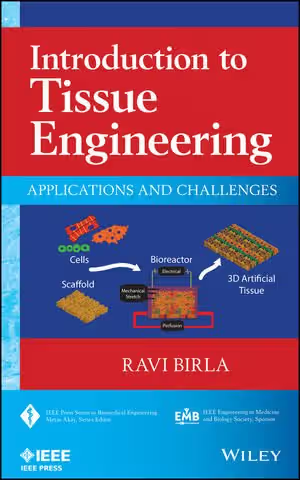
Birla, R. (2014). Introduction to Tissue Engineering: Applications and Challenges. Wiley-IEEE Press.
Chapter Summary
The book is a single-author textbook of nine chapters, about 360 pages, in the IEEE Press Series on Biomedical Engineering. The front matter includes a list of abbreviations and a section of important terminology and concepts. Every chapter opens with numbered learning objectives and a chapter overview, and closes with a summary, practice questions and references. The first six chapters set out the general framework and its enabling technologies; the last three apply that framework to three organs.
Chapter 1: Introduction to Tissue Engineering
The chapter frames the whole book. It starts from the chronic shortage of donor organs, using US waiting-list data for kidney and liver transplants, and introduces the tissue engineering paradigm through cardiovascular examples. It compares definitions of tissue engineering from the National Science Foundation, Eugene Bell, and Vacanti and Langer before offering the author's own. Its centrepiece is an eight-step process for fabricating 3D artificial tissue: cell sourcing, biomaterial synthesis, genetic manipulation, scaffold cellularization, embedded sensors, bioreactors, vascularization and in vivo assessment. It then treats fabrication as a design problem with controllable inputs and measurable outputs, names the three building blocks, and lists the open questions at each step. Later sections cover metrics for judging artificial tissue, seminal papers (especially Robert Langer's), uses of 3D tissue beyond transplantation, 2D versus 3D culture, the growth of the field, and how tissue engineering differs from related fields such as gene therapy, cell transplantation and regenerative medicine.
Chapter 2: Cells for Tissue Engineering
A cell biology chapter written for engineers: cell structure and function, the extracellular matrix, cell signalling and cellular junctions. It then turns to cell sourcing, cell transplantation (the process, the cells used and how they act) and the cell culture process, setting monolayer 2D culture against tissue engineering. The chapter closes with an introduction to stem cell engineering, covering human embryonic stem cells, induced pluripotent stem cells and adult stem cells.
Chapter 3: Biomaterials for Tissue Engineering
The chapter defines biomaterials and proposes a scheme for developing them, with a short history of the field. It covers tensile properties and how to modulate them, material degradation and biocompatibility, then classifies biomaterials and surveys biomaterial platforms, biomimetic and smart materials, and the extracellular matrix as a model, ending with the properties of an idealized biomaterial.
Chapter 4: Tissue Fabrication Technology
A survey of ways to assemble cells into tissue: self-organization, cell sheet engineering, scaffold-based fabrication, cell and organ printing, solid freeform fabrication, soft lithography and microfluidics, and cell patterning. It ends by describing an idealized system to support tissue fabrication.
Chapter 5: Vascularization of Artificial Tissue
The longest treatment of a single fabrication step. It begins with the biology (seminal angiogenesis research and the molecular mechanisms of vasculogenesis, angiogenesis and arteriogenesis) and therapeutic angiogenesis. It then builds a conceptual framework for vascularizing artificial tissue, reviews in vivo models, and offers an idealized strategy with a flow chart for decision making. Strategies are grouped as biologically replicated, biologically mediated and biologically inspired.
Chapter 6: Bioreactors for Tissue Engineering
Bioreactors are defined and classified, with design considerations and an idealized bioreactor system. The chapter then covers bioreactors for mammalian cell culture, scaffold fabrication and scaffold cellularization, followed by perfusion systems, mechanical stretch and electrical stimulation.
Chapter 7: Tracheal Tissue Engineering
The first of the three organ chapters follows a common pattern: structure and function of the trachea, the clinical problem (congenital and post-intubation or post-tracheostomy stenosis), its genetic regulation and current treatments, then design considerations, the process of bioengineering artificial tracheas, laboratory models, and two clinical studies.
Chapter 8: Bladder Tissue Engineering
The same pattern for the bladder: structure and function, neurogenic bladder dysfunction, surgical augmentation and bladder development, then design considerations and the fabrication process. Separate sections compare approaches based on cell sheets, small intestinal submucosa, PLGA scaffolds, acellular grafts and organ models, ending with a clinical study.
Chapter 9: Liver Tissue Engineering
The final chapter covers liver structure and function, acute liver failure, transplantation, regeneration and development, then design considerations and the process for bioengineering artificial liver tissue. It brings back the earlier enabling technologies one by one (stem cells, surface patterning, biomaterial platforms, 3D fabrication, vascularization and bioreactors) and ends with spheroid culture.
Key Concepts
Chapter 1: Introduction to Tissue Engineering
- Eight-step fabrication process: the book's organising scheme, running from cell sourcing to in vivo assessment.
- Tissue engineering as fabrication: a process with controllable inputs (cell numbers and types, fibre composition, porosity) and predefined output metrics.
- Building blocks: cells as the functional component, biomaterials as the structural component, and bioreactors as the source of guidance during maturation.
- Performance metrics: functional, biological and histological measures, judged against native tissue.
Chapters 2–3: Cells; Biomaterials
- Cell sourcing: choosing between primary cells and stem cells (embryonic, induced pluripotent, adult), and deciding how to expand and differentiate them.
- Cell transplantation versus tissue engineering: delivering cells alone compared with fabricating a 3D construct.
- Biocompatibility and degradation: how a material interacts with the host and how it breaks down over time.
- Idealized biomaterial: the target properties used to compare natural, synthetic and smart materials.
Chapters 4–6: Fabrication; Vascularization; Bioreactors
- Scaffold-free versus scaffold-based fabrication: self-organization and cell sheets compared with seeding cells on scaffolds, printing and freeform fabrication.
- Vasculogenesis, angiogenesis, arteriogenesis: the three routes by which blood vessels form, and the basis for vascularization strategies.
- Bioreactor stimulation: perfusion, stretch and electrical stimulation used to guide tissue maturation.
Chapters 7–9: Trachea; Bladder; Liver
- Design considerations: deriving requirements for an artificial organ from its structure, function and disease.
- Clinical translation: the clinical studies described for the trachea and bladder as tests of the fabrication process.
Critical Analysis
Strengths
- A single, consistent framework. The book was written by one author for teaching, and the eight-step process from Chapter 1 recurs throughout. The author has said that edited collections are hard to use in class because their chapters are inconsistent; this book avoids that problem.
- Built for a course. Learning objectives, overviews, summaries and practice questions in every chapter, a terminology section at the front, and instructor slides listed by the publisher make it straightforward to assign. The Chapter 1 questions ask students to reason as well as recall, for example by proposing two extra steps for the eight-step process.
- Engineering framing. The design-variable view of Chapter 1 and the "idealized" system sections in Chapters 3–6 give students a way to evaluate any approach against explicit requirements.
- Organ chapters that apply the framework. Chapters 7–9 each run from clinical need through design considerations to the fabrication process and, for the trachea and bladder, to clinical studies, showing how the general steps play out for real organs.
Limitations
- Uneven coverage of the eight steps. Cells, biomaterials, vascularization and bioreactors each get a chapter, but genetic manipulation, embedded sensors and in vivo assessment have no chapter of their own in the table of contents.
- Only three organs. Skin, cartilage, bone and cardiac tissue (the author's own research area) appear in Chapter 1 as active fields but have no dedicated chapters. The publisher's description mentions case studies, a section on future directions and coverage of pacemakers and prostheses, none of which appears as a section in the table of contents; the index lists cardiac pacemakers only within the bioreactor chapter's discussion of electrical stimulation.
- Dated. The book was published in 2014 and has not been revised, so later developments in organoids, bioprinting and clinical translation are missing.
- Little quantitative transport. The section headings point to conceptual and biological treatments; mass-transfer limits on thick constructs are not a separate topic.
Where It Fits in the Course
This is the natural first textbook in the course. Jonathan Slack's Stem Cells: A Very Short Introduction is a short, non-technical account of stem cell biology and therapies; reading it before or alongside Chapter 2 gives the biological background that Birla covers in a few sections. Van Blitterswijk and De Boer's Tissue Engineering is an edited, multi-author textbook of about 750 pages that covers the same fundamentals (cells, biomaterials, scaffolds, bioreactors) in more depth and many more tissues, ending with manufacturing and clinical translation. It is the logical second book after Birla.
Lanza, Langer, Vacanti and Atala's Principles of Tissue Engineering is a large reference work by leaders in the field, best used to look up specific tissues or technologies once Birla's framework is familiar. Ioannis Yannas's Tissue and Organ Regeneration in Adults is a focused monograph on induced regeneration in skin and peripheral nerve and on scaffold design; it suits students who want to go further into the scaffold side of Chapters 3–4.
How to Use This Book
The book suits undergraduates and beginning graduate students in biomedical engineering or the life sciences. Introductory cell biology and physiology help; Chapter 2 reviews the cell biology needed, and little mathematics is required.
A practical plan for a one-semester course:
- Core: Chapter 1 in full, since every later chapter refers back to the eight-step process and the three building blocks. Then Chapters 2, 3 and 6, the three building blocks in turn.
- Fabrication and vascularization: Chapters 4 and 5. Chapter 5 can be demanding because of its molecular biology; its flow chart for decision making is the part to master.
- Applications: choose one or two of Chapters 7–9 for detailed study, or assign each to a different group. For each organ, list the design considerations and match them against the eight steps, noting which steps the clinical studies actually addressed.
Use the learning objectives at the start of each chapter as a checklist and the practice questions for revision. Because the steps without their own chapters (genetic manipulation, sensors, in vivo assessment) and recent developments are only briefly covered, pair the book with review articles or with the relevant chapters of van Blitterswijk and De Boer.