01 / Reading Guide
Reading Guide
Citation
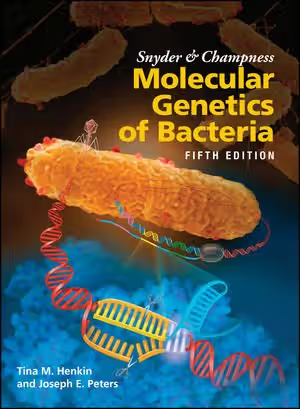
Henkin, T. M., & Peters, J. E. (2020). Snyder and Champness Molecular Genetics of Bacteria (5th ed.). ASM Press.
Chapter Summary
The book runs to about 640 pages: an unnumbered Introduction, thirteen chapters and a glossary. The publisher describes it as a new edition of a classic text, retitled in tribute to its founding authors, with the text centred on Escherichia coli and Bacillus subtilis and examples drawn from other bacteria of experimental, medical, ecological and biotechnological importance. Chapters end with a summary of main points, questions for discussion and suggested readings, and many carry numbered boxes.
Introduction
The introduction surveys the biological universe (bacteria, archaea, eukaryotes), defines what genetics is, and lists the practical features of bacterial genetics: haploid cells, short generation times, colony purification, serial dilutions, selections and stock storage. It also treats phage genetics and gives a brief history of the field, from transformation, conjugation and transduction through the genetic code, the operon model and synthetic genomics.
Chapters 1–2: The Bacterial Chromosome: DNA Structure, Replication, and Segregation; Bacterial Gene Expression: Transcription, Translation, Protein Folding, and Localization
Chapter 1 reviews DNA structure and the mechanism of replication, errors and impediments to replication, the link between replication and cell division, chromosome segregation, the nucleoid and the genome. Chapter 2 does the same for gene expression: RNA and protein structure, transcription, RNA degradation, translation, the genetic code, folding and degradation, protein localization and secretion, and a section titled "What You Need To Know" on reading frames and fusions.
Chapter 3: Bacterial Genetic Analysis: Fundamentals and Current Approaches
This is the methods chapter. It covers genetic terms and names, the Luria–Delbrück and Lederberg experiments, mutation rates, the types of mutations, reversion versus suppression, isolating and characterising mutants, complementation tests, and mapping by transduction, transformation and Hfr crosses.
Chapters 4–6: Plasmids; Conjugation; Transformation
Chapter 4 explains plasmid properties, replication control, maintenance (including par systems) and cloning vectors. Chapter 5 covers conjugation, the fertility plasmid, mobilisable plasmids, Hfr formation and integrating conjugative elements. Chapter 6 treats natural transformation, its regulation and role, and artificially induced competence.
Chapters 7–9: Bacteriophages and Transduction; Transposition, Site-Specific Recombination, and Families of Recombinases; Molecular Mechanisms of Homologous Recombination
Chapter 7 covers lytic and lysogenic development (with the λ system), phage genetic analysis, transduction, host defences such as CRISPR/Cas and restriction-modification, and phages as tools. Chapter 8 treats transposons, transposon mutagenesis, and site-specific recombinases. Chapter 9 explains homologous recombination in E. coli, phage recombination pathways and recombineering.
Chapter 10: DNA Repair and Mutagenesis
The chapter presents the evidence for DNA repair, repair of specific kinds of damage, mismatch repair, nucleotide excision repair, damage tolerance, the SOS response and translesion synthesis.
Chapters 11–12: Regulation of Gene Expression: Genes and Operons; Global Regulation: Regulons and Stimulons
Chapter 11 moves from negative and positive control of transcription initiation through attenuation, regulation of mRNA stability, translation and post-translational regulation. Chapter 12 covers carbon catabolite regulation, nitrogen assimilation, ribosome and tRNA synthesis, the stringent response, stress responses, iron regulation, virulence gene regulation and sporulation in B. subtilis.
Chapter 13: Genomes and Genomic Analysis
The final chapter covers the bacterial genome, DNA sequencing, PCR, restriction endonucleases, techniques for cloning and assembly, and CRISPR/Cas systems.
Key Concepts
Introduction and Chapters 1–3: foundations and genetic analysis
- Haploid genetics and selections: why bacteria suit experiments based on selecting rare variants.
- Classic experiments on mutation: the Luria–Delbrück and Lederberg experiments, which the chapter uses to show that mutants are clonal and to introduce mutation rates.
- Complementation and mapping: tests and crosses used to assign mutations to genes and place them on a map.
Chapters 4–9: moving and rearranging DNA
- Plasmids and conjugation: replicons that carry and transfer genes between cells.
- Natural transformation: uptake of DNA by competent cells.
- Transduction and lysogeny: gene transfer by phage and the maintenance of prophage.
- Transposition and site-specific recombination: movement and rearrangement of DNA by recombinase families.
- Homologous recombination: the RecBCD and RecF pathways, RecA, and recombineering.
Chapters 10–13: repair, regulation and genomes
- SOS response and translesion synthesis: inducible repair and tolerance of DNA damage.
- Operons and regulons: coordinated regulation of single operons and of larger sets of genes.
- Attenuation and RNA structure: control of transcription and translation through RNA conformation.
- CRISPR/Cas: introduced as a phage defence in Chapter 7 and treated as a molecular tool in Chapter 13.
Critical Analysis
Strengths
- A clear arc from DNA to genome. The order runs from replication and expression through genetic analysis, gene transfer, recombination and repair to regulation and genomics, and Chapter 3 gives the logic of the experiments before the specialised chapters use it.
- Integrated evidence. The publisher says biochemical, genomic and structural information are woven into the topics, and the section lists show experiment-level detail, such as the Luria–Delbrück and Lederberg experiments and a box on the Ames test in the repair and mutagenesis chapter.
- Study aids. Each chapter has a summary of main points, discussion questions and suggested readings, the book has a glossary, and numbered boxes connect topics to other organisms, including humans.
- Current subject matter. Recombineering, synthetic genomics, CRISPR/Cas and advanced sequencing methods appear in the contents.
Limitations
- Model-organism emphasis. The publisher states that the text is centred on E. coli and B. subtilis, so readers interested in other groups will see them mainly through examples.
- Genetics, not physiology. There are no chapters on metabolism, cell envelope biosynthesis or ecology as such; those topics are covered in a physiology text.
- Demanding for a first course. Wiley calls the book an undergraduate or beginning graduate textbook; with detailed mechanisms and thirteen long chapters it is better suited to students who have already completed introductory genetics or molecular biology.
- Genomics arrives last. Sequencing and genome analysis are placed in Chapter 13, after the molecular chapters, so the book builds from mechanisms to genomes rather than the other way round.
Where It Fits in the Course
This is the genetics-oriented advanced text on the microbiology list. Money's Microbiology: A Very Short Introduction, OpenStax Microbiology and Tortora et al.'s Microbiology: An Introduction are introductory, and Madigan et al.'s Brock Biology of Microorganisms is the general textbook whose genetics chapters are the natural preparation for this one.
White, Drummond and Fuqua's The Physiology and Biochemistry of Prokaryotes is its closest companion: that book covers growth, bioenergetics, metabolism, transport and signalling by topic, whereas Henkin and Peters's book covers how bacterial genes are replicated, expressed, exchanged, repaired, regulated and analysed. Reading the two side by side is a sensible route for a graduate course in bacterial molecular biology.
How to Use This Book
The book suits upper-level undergraduates and graduate students with introductory molecular biology and genetics. Researchers who work with bacteria will also find it useful as a reference.
A practical plan:
- Core: the Introduction, then Chapters 1–3 in order. Chapter 3 is the one to master before the rest, since later chapters use its genetic vocabulary and experiments.
- Gene transfer module: Chapters 4–9 can be read as a unit and in order.
- Regulation module: Chapters 11 and 12, with Chapter 2 as background.
- Optional by interest: Chapter 10 for DNA repair and Chapter 13 for genomic methods and CRISPR/Cas.
- Practice: use the discussion questions at the end of each chapter and follow the suggested readings to the original experiments.