01 / Reading Guide
Reading Guide
Citation
Kuriyan, J., Konforti, B., & Wemmer, D. (2012). The Molecules of Life: Physical and Chemical Principles. Garland Science.
Chapter Summary
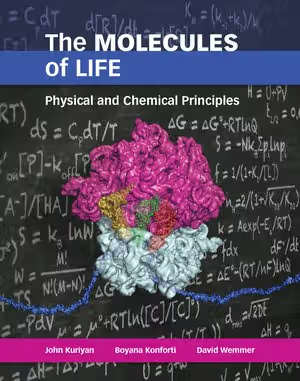
The book has nineteen chapters in six parts and about 1,000 pages. The publisher says its central theme is that the way proteins, DNA and RNA work together in a cell is tied to their structures, which in turn depend on atomic interactions and on the interplay of energy and entropy. It describes a quantitative treatment of energy and of the statistical basis of entropy, with detailed derivations and end-of-chapter problems, and says that students without a physical chemistry background can master the concepts. The publisher's contents list gives part headings only through the start of Part VI.
Part I, Biological Molecules (Chapters 1–5): From Genes to RNA to Proteins; Nucleic Acid Structure; Glycans and Lipids; Protein Structure; Evolutionary Variation in Proteins
The first part introduces the biological macromolecules and the flow from genes to RNA to proteins, then describes the structures of nucleic acids, glycans and lipids, and proteins, and the variation in proteins seen across evolution.
Part II, Energy and Entropy (Chapters 6–8): Energy and Intermolecular Forces; Entropy; Linking Energy and Entropy: The Boltzmann Distribution
The physical foundation. The chapters take up energy and the forces between molecules, entropy, and the Boltzmann distribution that links the two.
Part III, Free Energy (Chapters 9–11): Free Energy; Chemical Potential and the Drive to Equilibrium; Voltages and Free Energy
Free energy is introduced and then developed through chemical potential and the drive to equilibrium, and through the relation between voltages and free energy.
Part IV, Molecular Interactions (Chapters 12–14): Molecular Recognition: The Thermodynamics of Binding; Specificity of Macromolecular Recognition; Allostery
Binding is treated thermodynamically, followed by the specificity of macromolecular recognition and by allostery.
Part V, Kinetics and Catalysis (Chapters 15–17): The Rates of Molecular Processes; Principles of Enzyme Catalysis; Diffusion and Transport
Rates of molecular processes, the principles of enzyme catalysis, and diffusion and transport.
Part VI, Assembly and Activity (Chapters 18–19): Folding; Fidelity in DNA and Protein Synthesis
The last two chapters apply the earlier material to the folding of macromolecules and to the fidelity of DNA and protein synthesis.
Key Concepts
Parts I–II: structure and the physical basis (Chapters 1–8)
- Biomolecular structure: nucleic acids, glycans and lipids, and proteins (Chapters 2–4).
- Energy and intermolecular forces: Chapter 6.
- Entropy and the Boltzmann distribution: Chapters 7 and 8.
Parts III–IV: free energy and interactions (Chapters 9–14)
- Free energy and chemical potential: Chapters 9 and 10.
- Voltages and free energy: Chapter 11.
- Thermodynamics of binding and molecular recognition: Chapters 12 and 13.
- Allostery: Chapter 14.
Parts V–VI: rates, catalysis and assembly (Chapters 15–19)
- Rates of molecular processes and enzyme catalysis: Chapters 15 and 16.
- Diffusion and transport: Chapter 17.
- Folding and fidelity in DNA and protein synthesis: Chapters 18 and 19.
Critical Analysis
Strengths
- A physical framework for biochemistry. The six parts build from structure to energy, entropy, free energy, interactions and kinetics, and then apply these to folding and fidelity, so that the same ideas explain molecules in several settings.
- Accessible to non-physical-chemists. The publisher states that derivations are detailed and clear, and that students without a physical chemistry background should reach mastery with the end-of-chapter practice problems.
- Modular design. The publisher says the text is written to be flexible, not encyclopedic, so that it fits the goals of different instructors.
- Explicit link between structure and function. The first part sets out the macromolecules before any thermodynamics is introduced, which keeps structures in view throughout.
Limitations
- Not a survey of metabolism. The contents have no chapters on metabolic pathways or on the full range of biomolecules; students needing a standard biochemistry survey will need another text.
- Physics-heavy. Parts II–V are about energy, entropy, free energy, binding and kinetics; the site lists calculus and general chemistry as preparation.
- Limited external reviews. The sources reached for this guide are the publisher's pages, so the book's strengths are described as the authors and publisher present them.
Where It Fits in the Course
The Molecules of Life is the physical-chemistry-first text in the biochemistry list. Biochemistry: The Molecular Basis of Life and Essential Biochemistry are introductory texts, the second a concise book for a one-semester first course. Fundamentals of Biochemistry treats the subject with chemical rigour at full undergraduate scope, Biochemistry by Miesfeld and McEvoy ties molecular structure and metabolism to physiology and disease, and Lehninger Principles of Biochemistry is the comprehensive standard reference.
Read Kuriyan alongside or after one of the broad biochemistry textbooks, when the questions are about why molecules bind, fold and catalyse as they do.
How to Use This Book
It suits students who have taken introductory biochemistry and general chemistry and know calculus, in courses that emphasise physical principles.
- Core: Parts II–IV (Chapters 6–14) are the centre: energy, entropy, free energy and binding. Read them in order.
- Review or skim: Part I (Chapters 1–5) can be skimmed by readers who already know macromolecular structure.
- Kinetics and application: Part V and Chapters 18–19 apply the principles; Chapters 15–16 can be paired with an enzymology unit.
- Practice: work the end-of-chapter problems, since the derivations are the main teaching method.
- Pairing with a survey text: because the contents contain no chapters on metabolic pathways, use a broad biochemistry textbook from the list for pathways and use this book for the physical explanation of binding, folding and catalysis.
- Flexible use: the publisher describes the text as modular, so a course can take Parts II–IV as a short unit on the thermodynamics of biomolecules, or Parts IV–V for binding, allostery and kinetics.