01 / Reading Guide
Reading Guide
Citation
Saleh, B. E. A., & Teich, M. C. (2019). Fundamentals of Photonics (3rd ed., 2 vols.). Wiley.
Chapter Summary
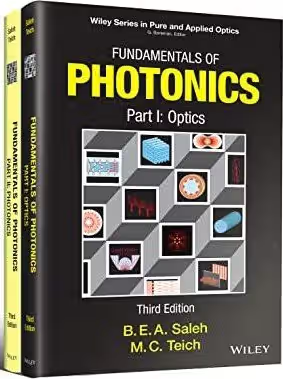
The third edition is a two-volume set of about 1,500 pages. Volume 1, Optics, has thirteen chapters; Volume 2, Photonics, has twelve more. Each volume carries appendices on the Fourier transform and linear systems, a list of symbols and units, and an index. The publisher says that each chapter contains highlighted equations, exercises, problems, a summary and a reading list, and that examples of real systems are included, and describes the sequence as preliminary sections that build toward more advanced topics.
Volume 1: Optics
The publisher presents four successive theories of light, which correspond to chapter titles in this volume: ray optics (Chapter 1), wave optics (Chapter 2), electromagnetic optics (Chapter 5) and photon optics (Chapter 13).
Chapters 1–3: Ray Optics; Wave Optics; Beam Optics
The book opens with the simplest model of light, rays, followed by the wave picture and then beams, a treatment that sits between the ray and wave descriptions.
Chapter 4: Fourier Optics
The publisher lists Fourier optics and holography among the more advanced topics to which the preliminary sections lead.
Chapters 5–6: Electromagnetic Optics; Polarization Optics
Light is described as an electromagnetic field, and polarization optics follows as a topic in its own right.
Chapters 7–8: Photonic-Crystal Optics; Metal and Metamaterial Optics
Chapter 7 treats periodic dielectric structures. Chapter 8 is the new chapter of the third edition: the publisher describes it as covering the optics of metals and plasmonic devices, and its title adds metamaterials.
Chapters 9–10: Guided-Wave Optics; Fiber Optics
Light confined in waveguides is the subject of Chapter 9, and optical fibers are treated separately in Chapter 10.
Chapters 11–13: Resonator Optics; Statistical Optics; Photon Optics
These chapters cover optical resonators, the statistical description of light, and photon optics, the fourth of the book's theories of light, which closes the first volume.
Volume 2: Photonics
The second volume moves from the properties of light to the devices that generate, modulate, detect and transport it.
Chapters 14–16: Light and Matter; Laser Amplifiers; Lasers
Chapter 14 treats the interaction of light and matter, which the publisher highlights alongside the four theories of light. Chapters 15 and 16 turn to laser amplifiers and lasers.
Chapters 17–19: Semiconductor Optics; LEDs and Laser Diodes; Photodetectors
Three chapters address semiconductor optics and the light emitters and detectors built from semiconductors.
Chapters 20–23: Acousto-Optics; Electro-Optics; Nonlinear Optics; Ultrafast Optics
The publisher lists acousto-optic and electro-optic devices, nonlinear optical devices and ultrafast optics among the advanced topics. These four chapters cover how light is controlled by sound and by electric fields, how intense light changes the medium it travels through, and how very short pulses are described.
Chapters 24–25: Optical Interconnects and Switches; Optical Fiber Communications
The book ends with systems: interconnects and switches in Chapter 24 and optical fiber communications in Chapter 25.
Key Concepts
Volume 1: Optics (Chapters 1–13)
- Ray, wave, electromagnetic and photon optics: four successively more complete descriptions of light, each valid in its own regime.
- Beam optics: the description of light that is neither a single ray nor a plane wave.
- Fourier optics: treating optical fields as sums of spatial frequencies, the basis of imaging and holography.
- Photonic crystals and metamaterials: structures whose periodic or engineered form shapes how light propagates.
- Guided waves and resonators: light confined in waveguides, fibers and cavities.
Volume 2: Photonics (Chapters 14–25)
- Light–matter interaction: absorption, emission and gain in atoms and solids, the basis for amplifiers and lasers.
- Semiconductor light sources and detectors: LEDs, laser diodes and photodetectors.
- Acousto-optic and electro-optic control: modulating light with sound waves or electric fields.
- Nonlinear and ultrafast optics: effects that depend on light intensity and the behaviour of very short pulses.
Critical Analysis
Strengths
- Scope in one set. The book runs from rays to optical fiber communications in a single sequence, so a reader can trace how each device rests on the earlier theory of light.
- Layered presentation. The publisher says that preliminary sections build toward advanced topics, which lets a course stop at an appropriate depth in each chapter.
- Study aids in every chapter. The publisher lists highlighted equations, exercises, problems, summaries and reading lists in each chapter, along with examples of real systems.
- Updated for the third edition. An entirely new chapter on metals and plasmonic devices was added, and each of the twenty-four chapters of the second edition was updated.
Limitations
- Very long. The two volumes run to about 1,500 pages, more than a single course can use, so the reader must choose chapters.
- Broad rather than specialized. With twenty-five chapters spanning optics and devices, an area such as nonlinear optics or semiconductor lasers receives one chapter or a few, less than a dedicated monograph would give.
- Growth between editions. The second edition had twenty-four chapters and the third adds a twenty-fifth, so the set is heavier than before; the publisher presents the book as an introductory-level text, but a course will have to select.
Where It Fits in the Course
Saleh and Teich is the most extensive book in this optics course list. French's Vibrations and Waves is a short first-year text on the wave motion that all of optics relies on, and Walmsley's Light: A Very Short Introduction gives a largely non-mathematical account of what light is. Hecht's Optics and Pedrotti's Introduction to Optics are undergraduate optics textbooks: Hecht develops the classical foundations and instruments, while Pedrotti moves from geometrical optics through wave optics to lasers with matrix methods throughout. Saleh and Teich overlaps with their subject matter in Volume 1 and then continues into devices and systems. Born and Wolf's Principles of Optics is the classical reference that develops optics from Maxwell's equations in full mathematical detail, a different kind of depth from the device orientation of this book.
How to Use This Book
The publisher presents the book as an introductory-level text in engineering and applied physics. Readers will be best prepared with courses in electromagnetism and waves and some familiarity with differential equations and Fourier analysis; quantum mechanics helps for the light–matter chapters.
A practical plan:
- Foundation: Chapters 1–6 give the ray, wave, beam, Fourier and electromagnetic descriptions plus polarization; for a student coming from an undergraduate optics course these can be read quickly, with Chapters 4 and 5 receiving the most attention.
- Choose by interest in Volume 1: Chapters 7–12 (photonic crystals, metals and metamaterials, guided waves, fibers, resonators, statistical optics) can be selected according to the course; Chapter 13 prepares for Volume 2.
- Devices in Volume 2: Chapters 14–16 and 17–19 are the core of a laser and optoelectronics course; Chapters 20–25 can be taken as separate modules on modulation, nonlinear and ultrafast optics, and optical communications.
Work the exercises and problems at the end of chapters, and use the appendices on the Fourier transform and linear systems whenever the mathematics of a chapter stalls.