01 / Reading Guide
Reading Guide
Citation
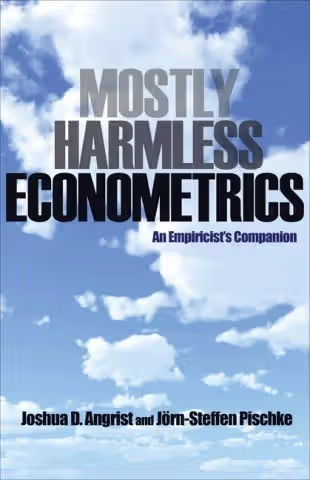
Angrist, J. D., & Pischke, J.-S. (2009). Mostly Harmless Econometrics: An Empiricist's Companion. Princeton University Press.
Chapter Summary
The book is short for a graduate econometrics text, with about 340 pages before the references, and is organised in three blocks: Preliminaries (Chapters 1–2), The Core (Chapters 3–5) and Extensions (Chapters 6–8), followed by a brief closing section. The publisher describes it as an irreverent review of econometric essentials that focuses on the tools applied researchers use most, and says it explains why fancier techniques are typically unnecessary and even dangerous.
Chapter 1: Questions about Questions
A short opening chapter, in Preliminaries, on the questions that motivate the methods. The publisher frames the whole book around clear causal questions such as whether smaller classes increase learning or how much education raises wages.
Chapter 2: The Experimental Ideal
Uses the randomized experiment as the benchmark for causal inference. The sections cover the selection problem, how random assignment solves it, and regression analysis of experiments.
Chapter 3: Making Regression Make Sense
A long chapter of about 85 pages at the start of the core. It covers regression fundamentals, the relationship between regression and causality, heterogeneity and nonlinearity, and a section on regression details. An appendix derives the average derivative weighting function.
Chapter 4: Instrumental Variables in Action: Sometimes You Get What You Need
Presents instrumental variables as a way to analyse natural experiments. Sections cover IV and causality, asymptotic two-stage least squares inference, two-sample and split-sample IV, IV with heterogeneous potential outcomes, generalizing the local average treatment effect (LATE), and IV details, with an appendix.
Chapter 5: Parallel Worlds: Fixed Effects, Differences-in-Differences, and Panel Data
Treats individual fixed effects, differences-in-differences, and the choice between fixed effects and lagged dependent variables, with an appendix on the latter.
Chapter 6: Getting a Little Jumpy: Regression Discontinuity Designs
Covers sharp regression discontinuity designs and the fuzzy design, which the chapter links to instrumental variables.
Chapter 7: Quantile Regression
Introduces the quantile regression model and IV estimation of quantile treatment effects, extending the analysis from conditional means to other parts of the distribution.
Chapter 8: Nonstandard Standard Error Issues
Deals with getting standard errors right: the bias of robust standard error estimates, and clustering and serial correlation in panels, with an appendix deriving the simple Moulton factor.
Last Words
A short closing section before the lists of acronyms, empirical studies and references.
Key Concepts
Preliminaries (Chapters 1–2)
- The selection problem: the difference between groups that arises because of who receives a treatment, not only because of the treatment itself.
- Random assignment: the experiment that removes selection and serves as the benchmark for non-experimental work.
The Core (Chapters 3–5)
- Regression and causality: when a regression coefficient can be read as a causal effect.
- Instrumental variables and LATE: using an instrument to identify the effect for those whose treatment it changes.
- Fixed effects and differences-in-differences: using repeated observations and policy changes to control for unobserved differences.
Extensions and Inference (Chapters 6–8)
- Regression discontinuity (sharp and fuzzy): exploiting a threshold in a rule to compare units just either side of it.
- Quantile regression: estimating effects at points of the outcome distribution other than the mean.
- Robust and clustered standard errors: inference that allows for heteroskedasticity and for correlation within groups.
Critical Analysis
Strengths
- A focused toolkit. The book concentrates on regression for statistical control, instrumental variables, differences-in-differences, regression discontinuity and quantile regression, plus standard errors. Reviewers quoted on the authors' site describe it as a distillation of knowledge usually acquired over many years (Amitabh Chandra, Harvard Kennedy School) and as an excellent mix of statistical detail, econometric intuition and practical instruction (Bill Evans, Notre Dame).
- Design before technique. Each tool is introduced as a way of answering a causal question, anchored in the experimental ideal of Chapter 2, which gives readers a consistent way to judge identification strategies.
- Many empirical examples. The publisher stresses numerous empirical examples from applied microeconomics, and the book ends with an index of the empirical studies it uses.
- Practitioner orientation. Sandra Black (UCLA) calls it a resource for anyone doing empirical work, not just students.
- Coverage of inference. A full chapter on standard errors, including clustering and serial correlation, gives practical guidance that textbooks of this length often omit.
Limitations
- Assumes a first course. The book is a companion rather than a first textbook; readers who have not seen ordinary least squares and basic probability will find it dense.
- A selective toolkit. The book concentrates on the methods of applied microeconomics, and its contents list no chapter on time-series methods, so it complements rather than replaces a full econometrics text.
Where It Fits in the Course
This is the most advanced econometrics book on the list, aimed at readers who will carry out applied microeconomic research. Stock and Watson's Introduction to Econometrics and Wooldridge's Introductory Econometrics: A Modern Approach are textbooks that teach regression, hypothesis testing, panel data and instrumental variables from the beginning, and are the right place to start; Studenmund's Using Econometrics teaches single-equation regression through intuition and practice rather than matrix algebra. Newbold and colleagues' Statistics for Business and Economics is a statistics text that supplies the probability and inference background.
The same authors' Mastering 'Metrics is the accessible companion: it presents five core tools through well-known studies using plain language and minimal notation. Reading it first, or alongside, makes the more formal treatment in Mostly Harmless Econometrics much easier to follow, and the authors' own site points readers who find the mathematics heavy to that book.
How to Use This Book
The book suits graduate students in economics and related fields and applied researchers who already know ordinary least squares and basic probability and statistics (expected values, variances, sampling distributions).
A practical plan:
- Core: Chapters 2 to 5 in order. Chapter 2 sets the logic; Chapter 3 repays careful reading, particularly its sections on regression and causality; Chapters 4 and 5 give the two main strategies for dealing with unobserved confounders.
- Extensions: Chapters 6 and 7 can be read in either order after Chapter 5.
- Inference: Read Chapter 8 before any empirical project, since it covers robust and clustered standard errors.
For each chapter, find one empirical study from the book's index of studies and read the original paper to see the method in use. Skip the appendices on a first pass and return to them for derivations.