01 / Reading Guide
Reading Guide
Citation
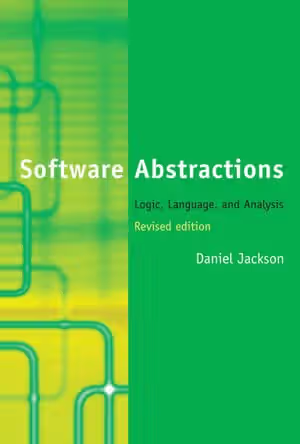
Jackson, D. (2012). Software Abstractions: Logic, Language, and Analysis (revised ed.). MIT Press.
Chapter Summary
The book (about 375 pages) presents Alloy, a modeling language based on relational logic, together with the Alloy Analyzer, which checks models automatically. Its argument is that the core of software development is the design of abstractions, and that code is a poor medium for exploring them: executability adds irrelevant detail, and a flaw that was invisible at design time becomes obvious at coding time. Alloy offers a notation chosen for ease of expression and an analysis that gives immediate feedback. The author calls the approach "lightweight formal methods": a small, simple notation as in traditional formal specification, but a fully automatic analysis in place of theorem proving. The revised edition updates the text, examples and appendices for Alloy 4. Chapter 1 is a short introduction, Chapters 2 to 5 teach the language, Chapter 6 gives larger examples, and five appendices follow.
Chapter 1: Introduction
The chapter argues that software is built on abstractions, that wishful thinking about untested abstractions is the usual failure, and that the remedy is to attack the design of abstractions head-on with a notation that can be analysed. It contrasts this with approaches that remove design as a separate phase.
Chapter 2: A Whirlwind Tour
An extended example, an address book, is built up in stages. The chapter explores states (statics), then adds operations (dynamics), a classification hierarchy and execution traces, giving the reader the whole workflow of simulate-check-refine before the details.
Chapter 3: Logic
The chapter lays out the logic underlying the language. It introduces "three logics in one", atoms and relations, snapshots, the operators, constraints, declarations and multiplicity constraints, and cardinality and integers.
Chapter 4: Language
Starting from a self-grandpas example, the chapter describes signatures and fields, model diagrams, types and type checking, facts, predicates, functions and assertions, commands and scope, modules and polymorphism, and integers and arithmetic.
Chapter 5: Analysis
This chapter explains how the Analyzer works from the user's side: scope-complete analysis, instances, examples and counterexamples, the problem of unbounded universal quantifiers, and scope selection and monotonicity. The preface says that the Analyzer translates constraints into boolean constraints for an off-the-shelf SAT solver.
Chapter 6: Examples
Four larger models: leader election in a ring, hotel room locking, media asset management and memory abstractions.
Appendices A–E
Appendix A contains exercises: logic exercises, extending simple models, classic puzzles, metamodels, small case studies and open-ended case studies. Appendix B is the language reference (lexical issues, grammar, precedence, semantics, types and overloading, language features, relational, integer and Boolean expressions). Appendix C gives the semantics of the Alloy kernel, Appendix D the diagrammatic notation, and Appendix E compares alternative approaches (B, OCL, VDM and Z) on the hotel-locking example.
Key Concepts
Chapters 1–2: Abstractions and the Workflow
- Software abstraction: a structure reduced to its essential form, which the book treats as the core of design.
- Lightweight formal methods: a precise notation with fully automatic analysis, built incrementally.
Chapters 3–4: Logic and Language
- Relational logic: sets and relations as the single building material of models.
- Signature and field: the way a model declares kinds of objects and relations among them.
- Fact, predicate, function, assertion: the constraint forms from which models and claims are written.
- Command and scope: what the Analyzer is asked to run or check, and within what bounds.
Chapter 5: Analysis
- Scope-complete analysis: exhaustive checking of every case up to a stated size.
- Instance and counterexample: an example of the model or a violation of an assertion, shown visually.
- Unbounded universal quantifier: a quantifier over unbounded sets, which scope-limited analysis cannot fully cover; Section 5.3 treats the issue.
Critical Analysis
Strengths
- A clear thesis about design. The preface and Chapter 1 argue why abstractions deserve explicit, early attention, and the title names that theme.
- Learning with feedback. The preface describes building a model incrementally with the Analyzer, simulating and checking as you go, with instant visual feedback and the experience of finding errors in one's own models.
- A graded path. The whirlwind tour comes before the logic and language chapters, so the reader sees the workflow first. The appendix gives exercises in six groups from logic exercises to open-ended case studies.
- Fully worked cases and models. Chapter 6 models four systems, and the book's website provides all the models for download.
- Reviews. George Hacken (Computing Reviews) gave it his highest recommendation for the examples and exercises; Anthony Sloane (Journal of Functional Programming) wrote that systems like Alloy should be in the toolbox of every designer and developer.
Limitations
- Tool version. The revised edition is compatible with Alloy 4; the Alloy site now lists a newer online book, Practical Alloy, that covers Alloy 6 features such as temporal modeling.
- Bounded analysis. The method checks every case up to a stated scope, so a model that passes is not proved correct at every size; Chapter 5 devotes sections to unbounded universal quantifiers and to choosing a scope.
- Needs a logical background. The material rests on sets, relations and first-order logic, which suits readers comfortable with discrete mathematics.
- Design models, not programs. The models describe designs rather than code; the only comparison with other specification approaches is Appendix E, which sets Alloy beside B, OCL, VDM and Z on the hotel-locking problem.
Where It Fits in the Course
This is the formal-methods book of the software-engineering list. A Philosophy of Software Design is a short book on managing complexity through deep modules and information hiding; it shares Jackson's concern with abstractions but expresses it as practical advice. Software Architecture in Practice treats architecture and quality attributes in real projects, Software Engineering by Sommerville is a broad introduction that follows a system's whole life, The Pragmatic Programmer is a collection of practical habits, and Software Engineering at Google explains how one large organisation sustains software over time.
Read Software Abstractions when you have a broad picture of software engineering and want a rigorous way to check a design before building it. It complements, rather than replaces, those practical books.
How to Use This Book
The book is for readers comfortable with sets, relations and first-order logic and with some experience of software design. Endorsements on the book's website describe readers ranging from working practitioners to researchers.
A practical plan:
- First pass: Chapter 1, the whirlwind tour in Chapter 2, and Chapter 4 on the language, installing the Alloy Analyzer and running the book's models from the website.
- Core: Chapter 3 (logic) alongside Chapter 4, then Chapter 5 for how to read analysis results and choose scopes.
- Applications: work through at least one model in Chapter 6 (hotel room locking is the problem Appendix E uses to compare notations) and modify it.
- Practice: do the exercises of Appendix A, moving from the logic exercises to the small case studies; use Appendix B as the language reference and Appendix E to compare notations.